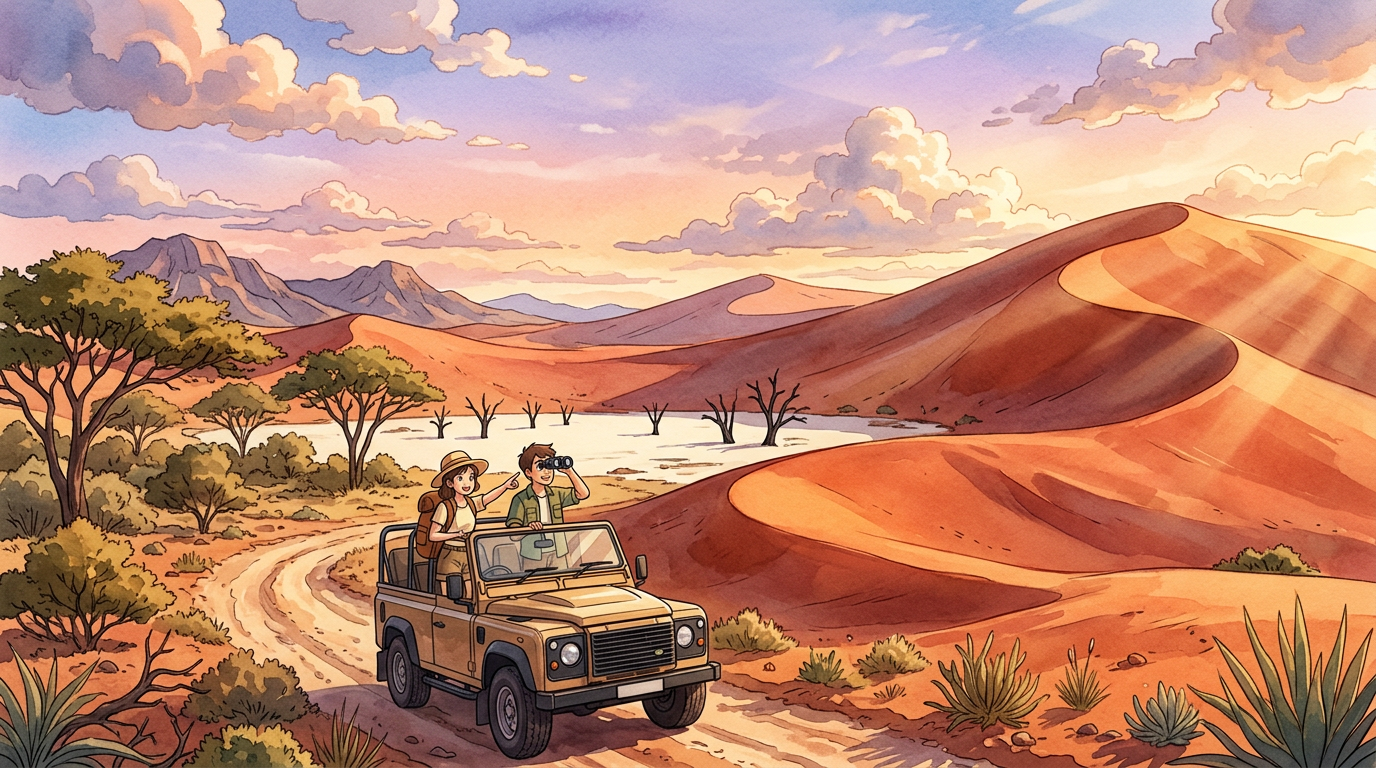
Namibia
Where towering dunes meet the Atlantic and wildlife roams vast salt pans.
Daily Budget Guide
| Category | Budget | Mid-Range | Luxury |
|---|---|---|---|
| Stay | NAD 500 | NAD 1,800 | NAD 8,500 |
| Food | NAD 350 | NAD 800 | NAD 2,000 |
| Transport | NAD 300 | NAD 600 | NAD 1,500 |
| Activities | NAD 200 | NAD 600 | NAD 1,500 |
| Daily Total | NAD 1,350 | NAD 3,800 | NAD 13,500 |
Tipping: Tipping is customary in restaurants at 10% of the bill. For safari guides and lodge staff, a tip of 100-200 NAD per day is appreciated.
Stay Connected in Namibia
Coverage
5G Available
Airport WiFi
Recommended Data
eSIM tip: Mobile coverage is excellent in urban centers but sparse in remote desert areas. We recommend purchasing a Hello eSIM before departure to ensure you have data ready upon arrival.
Quick Reference
- Visa
- Citizens of many countries, including the UK, USA, and most EU nations, can enter visa-free for up to 90 days. Visa-on-arrival is available for several other nationalities at Hosea Kutako International Airport.
- Language
- English (Official), Oshiwambo, Afrikaans, German
- Best Time
- May to October
- Timezone
- CAT (UTC+2)
- Power
- Type D/M, 220V
- Emergency
- 10111 (Police), 211111 (Ambulance)
Top Cities to Visit
Windhoek
The highland capital with a German colonial heartbeat.
As the primary gateway to the country, Windhoek offers a blend of African culture and German colonial architecture. It is the best place to arrange 4x4 rentals and stock up on supplies before heading into the wilderness.
Swakopmund
Namibia's premier adventure and seaside playground.
Nestled between the desert and the ocean, this city is the hub for adrenaline seekers. Visit for sandboarding, skydiving, and exploring the nearby Moon Landscape and Welwitschia plains.
Walvis Bay
A coastal sanctuary for flamingos and marine life.
Famous for its natural lagoon and abundant birdlife, it is the best spot for dolphin cruises and kayaking with seals. The nearby Pelican Point offers a unique perspective of the rugged Atlantic coast.
Lüderitz
A surreal harbor town frozen in time.
Known for its colorful Art Nouveau architecture and its proximity to Kolmanskop, a famous diamond-mining ghost town being reclaimed by the desert sands. It offers a stark, hauntingly beautiful coastal experience.
What to Eat in Namibia
Expect to spend $350–$2000 per day on food, depending on your style.
Navigating the Wild: Transport and Connectivity
Namibia is a destination defined by its vast, open spaces, making a self-drive safari the ultimate way to explore. To truly experience the rugged beauty of the Skeleton Coast or the remote reaches of Damaraland, renting a 4x4 vehicle is highly recommended. While the main B-roads are paved, many of the most scenic routes consist of salt or gravel tracks where tire pressure management is key.
Because distances between towns are immense, staying connected is a safety essential. You can buy and activate a Hello eSIM before you even touch down at Hosea Kutako International Airport, ensuring you have data for navigation and emergency contact without facing international roaming charges. While signal can be sparse in the deep desert, having a reliable connection in hubs like Windhoek and Swakopmund allows you to download offline maps and stay in touch with your lodges. Use the Hello trip planning feature to map out your fuel stops—petrol stations can be hundreds of kilometers apart, and it is a local rule of thumb to never pass a pump without topping up.
Iconic Landscapes and Wildlife Planning
No trip to Namibia is complete without witnessing the sunrise over the iron-oxide sands of Sossusvlei. Aim to be at the park gates at opening to climb Big Daddy, the tallest dune in the area, before the heat becomes intense. For wildlife enthusiasts, Etosha National Park offers a unique safari experience where animals come to you; during the dry season, simply park your vehicle near one of the many waterholes like Okaukuejo and watch as herds of elephants, lions, and the endangered black rhino gather.
Organizing such a diverse itinerary requires precision. You can use the Hello app to organize your daily schedule, from sunrise photography sessions at Deadvlei to afternoon dolphin cruises in Walvis Bay. Since many of the best lodges and campsites book up six to twelve months in advance, having your confirmations and route details stored in one place makes the journey much smoother. Remember to pack layers; while desert days are scorching, temperatures in the Namib-Naukluft can drop toward freezing once the sun sets.
Budgeting and Local Currency Essentials
The local currency is the Namibian Dollar (NAD), which is pegged 1:1 to the South African Rand (ZAR). Both currencies are used interchangeably throughout the country. For a mid-range dinner at a popular spot like Joe’s Beerhouse in Windhoek, expect to pay around NAD 280 (approx. $15 USD) for a hearty game steak and a local Windhoek Lager. Tipping is customary at around 10% for good service in restaurants, and it is polite to give small change to car guards who watch your vehicle in urban areas.
To keep your finances in check while exploring, use the Hello budget tracking feature to record your spending in NAD. This is particularly helpful for monitoring fuel costs and park entrance fees, which for international visitors are currently NAD 150 (approx. $8 USD) per person per day at major parks like Etosha. If you are traveling with a group, the expense splitting tool in the app is perfect for divvying up the costs of a shared 4x4 rental or communal grocery hauls for campfire braais (barbecues) under the stars.
Frequently Asked Questions About Namibia
Is it safe to travel to Namibia?
Do I need a 4x4 vehicle to get around?
How can I stay connected while exploring remote areas?
What is the best time for wildlife viewing?
Can I use South African Rand in Namibia?
Is English widely spoken in Namibia?
Ready for Namibia?
Download Hello for eSIM connectivity, expense splitting, and budget tracking — your all-in-one trip companion.
Similar Destinations
Related Articles
Namibia in 10 Days: The Ultimate Travel Itinerary
A comprehensive 10-day itinerary for Namibia covering top attractions, hidden gems, daily costs, and transport between cities.
8 min read
3 Days in Namibia: A Day-by-Day Itinerary
A detailed 3-day itinerary for Namibia with daily activities, costs, neighborhoods, and transport tips.
8 min read
Namibia in 5 Days: The Perfect Extended Itinerary
A detailed 5-day itinerary for Namibia with daily activities, costs, neighborhoods, and transport tips for an extended stay.
8 min read