Sudan Food Guide: Must-Try Dishes, Prices, and Tips
Best local dishes, street food, restaurant prices, dietary options, and food safety tips for Sudan.
By Hello Travel Team
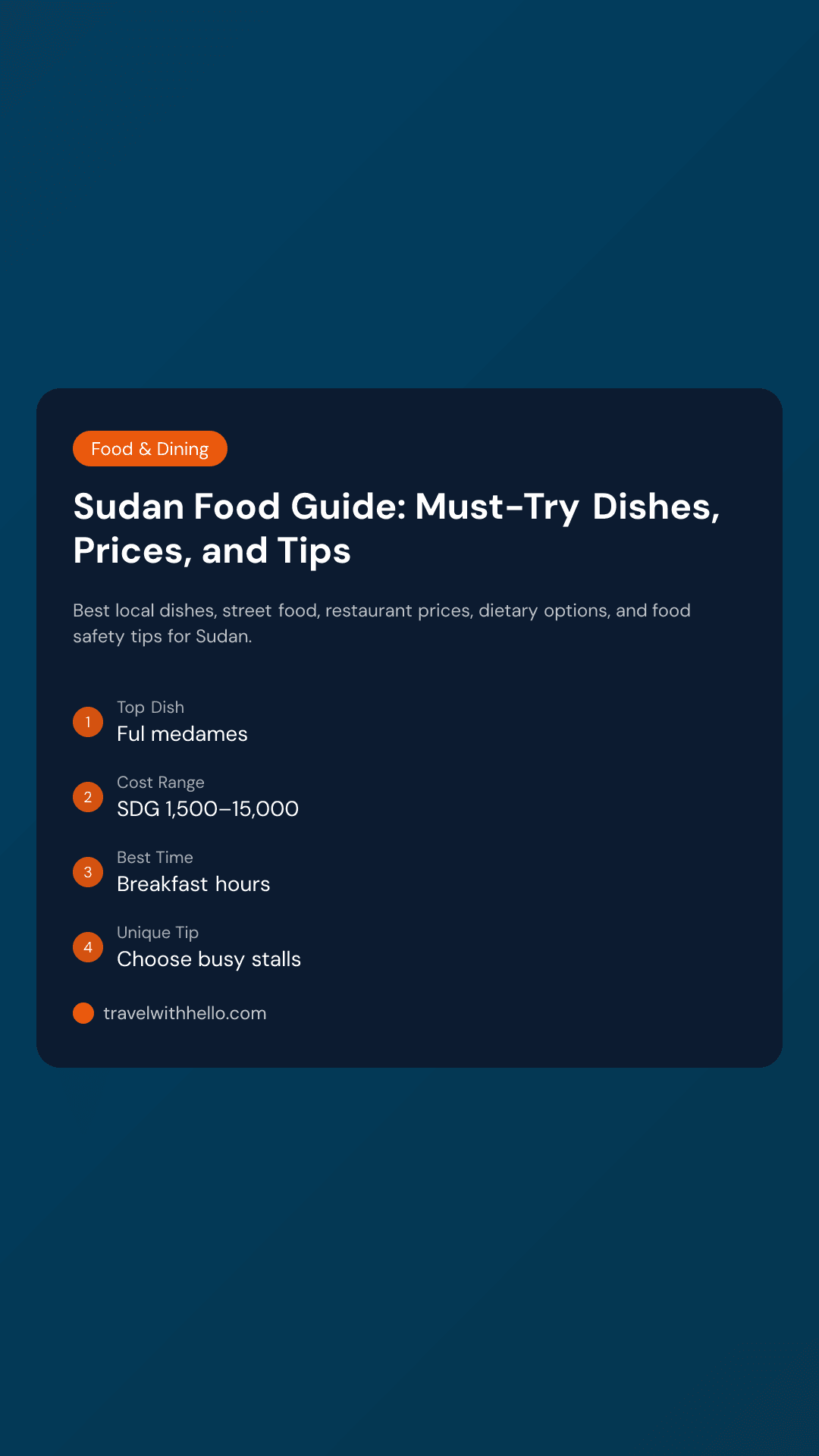
TL;DR: Sudan Food Guide at a Glance
Sudan’s food is filling, affordable, and built around ful, kisra, gurasa, asida, savory stews, grilled meat, tea, and spiced coffee. For a practical 2026 budget, allow roughly SDG 1,500–5,000 (about US$2–8, subject to rapid exchange-rate changes) for street food or a simple local meal, and around SDG 4,000–15,000 (US$6–25) at a mid-range restaurant. Prices vary sharply by city, availability, and currency conditions.
The best way to explore what to eat in Sudan is to start with local breakfast stalls, try Sudanese tamia and ful, then order kisra or gurasa with a mullah stew. Vegetarian food is available, especially at breakfast, but meat stock, ghee, or eggs may appear unless you explain your requirements clearly. Drink sealed or reliably treated water, be cautious with ice and raw produce, and carry oral rehydration salts. If travelling with friends, Hello’s AI receipt scanning and multi-currency budget tracking can help record shared meals and convert changing prices automatically.
Sudan Must-Try Food: Ful, Kisra, Gurasa, and Traditional Stews
The essential Sudan must-try food is a combination of seasoned beans, fermented flatbread, thick griddle bread, and mullah—saucy stews served communally or with bread. Ful medames is the classic breakfast: slow-cooked fava beans finished with oil, garlic, lemon or lime, cumin, chili, onions, tomatoes, and sometimes egg or cheese. It is inexpensive, substantial, and widely available from early morning.
Kisra is a thin, slightly tangy fermented sorghum or wheat flatbread commonly used to scoop up stew. Gurasa is thicker and more pancake-like, often topped or served alongside meat, vegetables, or sauce. Asida is a smooth, dough-like porridge made from wheat or sorghum flour, traditionally paired with mullah.
Look for mullah bamia, an okra stew; mullah ahmar, a tomato-based red meat sauce; mullah al-rob, a yogurt-style stew; and kamounia, a cumin-seasoned meat dish. Sudanese food also reflects Nile, Arab, Sahelian, and East African influences, so menus can differ between Khartoum, Omdurman, Port Sudan, and smaller communities. Eat with the right hand when sharing, and accept extra bread or sauce as part of the meal.
Sudan Street Food and Drinks: What to Order and What It Costs
Sudan street food is usually the cheapest and most atmospheric way to eat, with breakfast stalls, tea sellers, and small grills serving quick meals near markets and busy streets. Expect approximately SDG 500–2,000 (US$0.75–3) for ful, tamia, bread, or a simple snack in 2026, although prices can change quickly and foreign-currency conversions are only estimates.
Sudanese tamia resembles falafel but is commonly made with fava beans, herbs, garlic, onion, and spices before being deep-fried. Order it in bread with salad and tahini where available. Other useful street-food discoveries include boiled eggs with spices, grilled meat, simple rice plates, fried dough, and fresh bread. In Omdurman and Khartoum, women’s tea and coffee stalls may serve spiced tea or gahwa, a small-cup coffee infused with ginger, cardamom, or cloves.
| Food or drink | Typical 2026 price | Approximate USD |
|---|---|---|
| Ful with bread | SDG 500–1,500 | US$0.75–2.50 |
| Tamia sandwich | SDG 700–2,000 | US$1–3 |
| Tea or small coffee | SDG 300–1,000 | US$0.50–1.50 |
| Simple grilled-meat plate | SDG 2,000–5,000 | US$3–8 |
Carry small notes, confirm the price before ordering, and avoid assuming that a menu price includes drinks or side dishes.
Restaurant Prices in Sudan: Street Stalls Compared with Local Dining
A realistic Sudan food budget is about SDG 1,500–5,000 (US$2–8) for an inexpensive local meal, SDG 4,000–15,000 (US$6–25) at a mid-range restaurant, and US$30 or more at an international hotel restaurant in 2026. Inflation, supply disruptions, location, and the exchange rate can make published prices unreliable, so treat these as planning ranges rather than fixed tariffs.
Local Sudanese restaurants generally offer the best value for filling portions of ful, rice, chicken, beef, stews, or bread. Lebanese, Egyptian, and hotel restaurants in larger cities tend to cost more but may provide air conditioning, clearer menus, card facilities, and more predictable hygiene standards. Outside major urban areas, choices can be limited and a basic meal may be the only practical option.
| Dining style | Typical cost per person | What to expect |
|---|---|---|
| Street stall or tea stand | SDG 300–2,000 / US$0.50–3 | Ful, tamia, tea, bread, quick snacks |
| Basic local restaurant | SDG 1,500–5,000 / US$2–8 | Rice, stew, chicken, meat, vegetables |
| Mid-range restaurant | SDG 4,000–15,000 / US$6–25 | Larger menu, seating, soft drink |
| Hotel or upscale dining | US$30–50+ | International dishes and premium setting |
Keep cash available, ask whether service is included, and use Hello’s receipt scanner to capture bills in Arabic or English and convert them into your home currency.
Dietary Options in Sudan: Halal, Vegetarian, and Vegan Eating
Halal food is the norm in Sudan, while vegetarian and vegan eating is possible but requires precise questions because dishes may contain meat stock, ghee, yogurt, egg, or butter. Beans, lentils, okra, vegetables, rice, kisra, and tamia provide a strong base for plant-based meals, especially at breakfast and in traditional home-style restaurants.
Vegetarians can request ful without meat, vegetable mullah, okra stew, rice with vegetables, tamia, or bread with tahini. Vegans should specify no meat, chicken, fish, dairy, butter, ghee, or egg; simply saying “vegetarian” may not be enough. Kisra and some breads are plant-based, but preparation varies. Ask whether the cooking oil is shared and whether sauces contain yogurt or animal stock.
Useful phrases include “ana nabati” for “I am vegetarian” and “bidun lahm” for “without meat.” Showing a translated note on your phone is often easier than explaining several ingredients. Fish is more common near Port Sudan and the Red Sea, while meat and legumes dominate many inland menus. During Ramadan, daytime food availability changes, and eating discreetly away from public areas is respectful. Alcohol is not part of ordinary dining culture, and restaurants generally focus on tea, coffee, juices, and soft drinks.
Food Safety Tips for Travellers Eating in Sudan
The safest Sudan food strategy is to choose busy stalls with rapid turnover, eat food served piping hot, drink sealed or reliably treated water, and treat raw produce, ice, and unpasteurized ingredients cautiously. Carry hand sanitizer, oral rehydration salts, and any medication recommended for your trip.
Choose fruit that you can peel yourself, such as bananas or oranges, and avoid salads unless washed with safe water. Check that meat is thoroughly cooked and that hot food has not been sitting uncovered for long periods. Fresh bread, cooked beans, and food prepared in front of you are often more practical choices than lukewarm buffet dishes. Avoid tap water unless local authorities or trusted accommodation confirm it is treated and safe.
Before eating, wash hands or use sanitizer, particularly when sharing bread or eating with your right hand. Keep separate utensils for personal medication and avoid dairy that has not been refrigerated. If diarrhoea, vomiting, fever, or dehydration develops, prioritize fluids and seek qualified medical help; severe symptoms need urgent attention. Conditions and access can vary considerably by region, and travellers should check current official advisories before departure, especially because conflict and supply disruptions may affect restaurant operations and food availability.
Common Questions About What to Eat in Sudan
Travellers most often ask whether Sudan is expensive, what to order first, whether delivery exists, and how much to tip; the short answers are that local food is usually inexpensive, ful and tamia are the easiest introductions, delivery is limited and location-dependent, and small cash tips are appreciated when service is good.
What should a first-time visitor eat in Sudan? Start with ful for breakfast, tamia as street food, then try kisra or gurasa with mullah bamia, mullah ahmar, or a chicken stew. Finish with spiced tea or Sudanese gahwa.
Is Sudanese food spicy? Some dishes are mild, but chili and spice condiments may be served separately. Ask for less chili if needed.
Are food delivery apps available in Sudan? App-based delivery is much less consistent than in major Gulf or European destinations. Some restaurants use phone, WhatsApp, or locally arranged drivers, but coverage, payment, and operating hours vary. Ask your hotel or host for current local options.
Should visitors tip in Sudan? Tipping is not always mandatory. Round up a small bill or leave roughly 5–10% when service is good, particularly at restaurants serving tourists or in hotels. Confirm that a service charge is not already included.
How can travellers track food spending? Hello supports AI receipt scanning in multiple languages and currencies, voice expense entry, automatic exchange rates, expense splitting, and budget categorization—useful when several people share a large meal or prices change during a trip.
For broader planning, see the Sudan destination guide. To arrive connected for maps, translation, and contacting accommodation, consider Hello eSIM for Sudan, activated before departure.
Explore These Destinations
Stay Connected
Make the most of Sudan
From eSIM connectivity to expense tracking, Hello is the all-in-one companion that keeps your trip stress-free.
Related Articles
Sudan in 10 Days: The Ultimate Travel Itinerary
A comprehensive 10-day itinerary for Sudan covering top attractions, hidden gems, daily costs, and transport between cities.
4 November 2026
3 Days in Sudan: A Day-by-Day Itinerary
A detailed 3-day itinerary for Sudan with daily activities, costs, neighborhoods, and transport tips.
4 November 2026
Sudan Cultural Guide: Etiquette, Customs, and Tips
Essential do's and don'ts, greeting customs, dress codes, local phrases, and cultural tips for Sudan.
4 November 2026