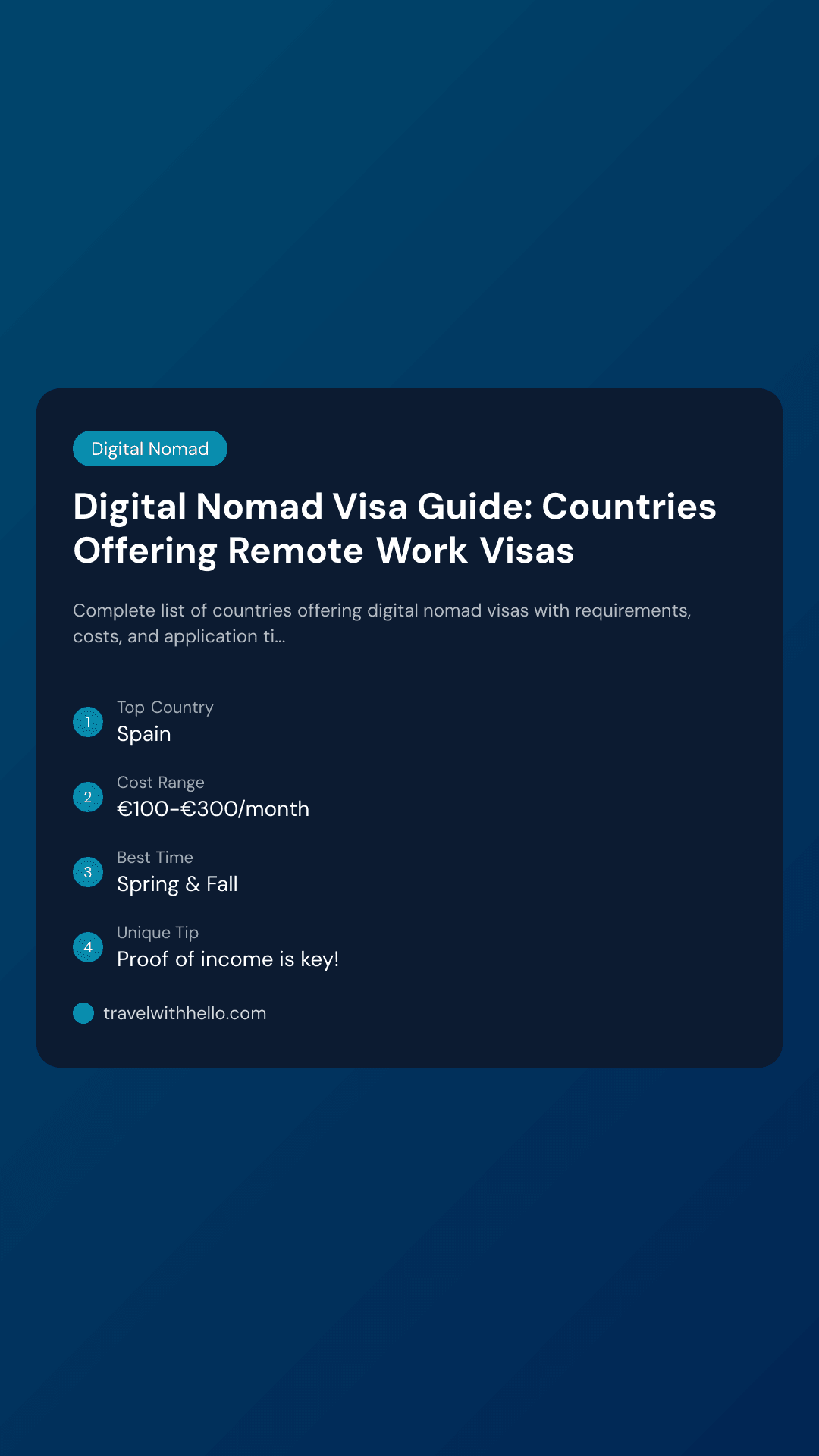
Digital Nomad Visa Guide: Countries Offering Remote Work Visas
Complete list of countries offering digital nomad visas with requirements, costs, and application tips.
By Hello Travel Team
TL;DR: Best Digital Nomad Visa Countries in 2026
A digital nomad visa lets location-independent employees, freelancers, and business owners live legally in a country while working remotely for clients or employers abroad. In 2026, popular nomad visa countries include Portugal, Spain, Croatia, Greece, Estonia, Costa Rica, Georgia, Malaysia, Thailand, the United Arab Emirates, and Colombia; most require proof of foreign income, health insurance, accommodation, and a clean criminal record.\n\nFor a European base, compare Portugal, Spain, Croatia, and Greece. For lower everyday costs, consider Georgia, Colombia, Malaysia, or Thailand. Requirements change frequently, so confirm income thresholds, tax rules, fees, and application procedures with the destination’s immigration authority before booking a long stay.
What Is a Digital Nomad Visa and Who Can Apply?
A remote work visa is designed for people who earn income from employers, clients, or businesses outside their destination country and want to stay longer than a standard tourist allowance. Unlike a conventional work permit, it generally does not authorize employment for a local company. Most programmes require a valid passport, proof of remote work, minimum monthly income, health insurance, accommodation, and a criminal-record certificate.\n\nCommon evidence includes an employment contract, client agreements, company registration, recent bank statements, payslips, tax returns, and a letter confirming that your work can be performed abroad. Requirements vary by nationality and family size: Spain, for example, may require additional monthly income for dependants, while Costa Rica generally asks applicants to demonstrate higher earnings when bringing family.\n\nBefore applying, check three separate issues:\n\n- Visa eligibility: Confirm that your profession, nationality, employer, and income source qualify.\n- Tax exposure: A visa does not automatically make foreign income tax-free. Residency days, local rules, treaties, and social-security obligations matter.\n- Practical setup: Verify internet reliability, time-zone compatibility, banking access, healthcare, and whether your accommodation allows working.\n\nApply with documents translated, notarized, or apostilled where required. Keep digital and printed copies, and leave several weeks for background checks and processing.
Nomad Visa Countries Compared: Requirements, Costs, and Length of Stay
The best work abroad visa depends on your income, preferred climate, tax position, and desired length of stay; no single programme is cheapest or easiest for every remote worker. The figures below are practical 2026 planning estimates, but authorities may update thresholds or fees during the year.\n\n| Country | Approx. income requirement | Typical validity | Approx. application cost | Estimated monthly living cost |\n|---|---:|---:|---:|---:|\n| Portugal | €3,680/month | 1 year, with residence route | €90–€200 | $2,000–$3,200 |\n| Spain | About €2,850/month | 1 year or longer residence route | €100–€250 | $2,000–$3,300 |\n| Croatia | €3,622.50/month | Up to 18 months | About €80–€150 | $1,600–$2,700 |\n| Greece | About €3,500/month | Usually 1 year | About €75–€150 | $1,500–$2,600 |\n| Estonia | About €4,500/month | 1 year, generally non-renewable | About €100–€120 | $1,700–$2,800 |\n| Costa Rica | $3,000/month individual | 1 year, renewable once | About $100–$300 | $1,500–$2,500 |\n| Georgia | $2,000/month | 1 year, commonly renewable | No programme fee reported | $900–$1,600 |\n| Malaysia | About $24,000/year | 3–12 months, depending on approval | Around RM1,000 | $1,200–$2,200 |\n\nThese estimates combine published 2026 visa comparisons with typical housing, food, transport, and coworking budgets. Portugal and Spain offer stronger long-term European infrastructure but higher rents in Lisbon, Porto, Madrid, and Barcelona. Georgia is notably affordable, while Croatia’s coastal cities become much more expensive during July and August.
Best European Digital Nomad Visa Options for Remote Workers
Portugal, Spain, Croatia, and Greece are the strongest European choices when you want reliable infrastructure, international communities, and access to multiple countries, but housing costs and tax residence require careful planning. Portugal’s D8 route suits remote employees and freelancers who can document regular foreign income; Lisbon and Porto have established coworking scenes, though central rents can consume much of a nomad budget. Consider Braga, Coimbra, or Madeira for a slower and sometimes cheaper base.\n\nSpain’s international telework visa is attractive for people who want large-city amenities, excellent rail connections, and communities in Valencia, Málaga, Madrid, or Barcelona. Valencia often offers a better cost-to-lifestyle balance than Barcelona. Spain may also offer a tax regime that can reduce taxation for qualifying applicants, but eligibility should be reviewed with a tax professional rather than assumed.\n\nCroatia allows a stay of up to 18 months in many cases and is popular in Split, Zagreb, and Dubrovnik. Split is sociable and coastal, but summer accommodation prices rise sharply. Greece combines islands, mainland cities, and a lower-cost lifestyle outside Athens, with Thessaloniki and Crete offering growing remote-work communities.\n\nFor connectivity, coworking spaces in major European cities commonly cost $200–$450 per month in 2026, while hot desks in Southeast Asia and some secondary cities can cost $80–$200. Always test your accommodation’s upload speed and backup options before committing to client calls.
Affordable Nomad Visa Countries in Asia and the Americas
Georgia, Malaysia, Thailand, Colombia, and Costa Rica can lower living costs without sacrificing access to cafés, coworking spaces, and established expat networks. Tbilisi is a strong budget base: furnished apartments, cafés, and coworking desks can be substantially cheaper than Western Europe, and the city’s compact centre makes networking easy. Check winter heating and apartment internet before signing a lease.\n\nMalaysia’s DE Rantau programme is suited to remote professionals who want modern infrastructure, affordable food, and regional flight connections. Kuala Lumpur offers fast urban internet and extensive coworking, while Penang provides a more relaxed lifestyle. A typical coworking membership may cost $100–$250 monthly, depending on location and amenities.\n\nThailand’s major nomad hubs include Chiang Mai, Bangkok, Phuket, and Thailand. Chiang Mai is often the value choice, although seasonal air pollution can affect outdoor life. Bangkok offers better transport and networking but higher rent in central neighbourhoods.\n\nIn the Americas, Colombia’s Medellín combines mild weather, cafés, and a visible remote-worker community, while Costa Rica offers beaches and nature at a higher price. Expect roughly $1,200–$2,400 monthly in Medellín for a careful single-person budget and $1,500–$2,500 in Costa Rica, excluding international flights. Use coworking communities, language exchanges, and professional meetups to build contacts beyond tourist circles.
Internet, Coworking, and Staying Connected on a Work Abroad Visa
Reliable connectivity should be part of your visa plan: choose accommodation with verified fibre or cable internet, keep mobile data as a backup, and test video calls before starting work. A fast speed test is useful, but consistency, upload speed, latency, and power reliability matter more than a headline download number. Ask hosts for recent results and whether the router is inside the apartment.\n\nCoworking spaces are useful for stable calls, ergonomic desks, meeting rooms, and community events. In 2026, plan approximately $80–$200 monthly for a hot desk in many Asian or Latin American hubs and $200–$450 in popular Western European cities. Day passes commonly cost $10–$30. Before joining, confirm opening hours, quiet-call policies, backup power, and whether the space has private booths.\n\nYou can arrive connected by purchasing and activating Hello eSIM for Japan before departure if Japan is your next base. Hello’s eSIM plans cover 200+ countries, start from 5GB, activate instantly, and use live pricing, so you can keep a data connection while collecting keys, navigating to accommodation, or arranging a local broadband plan.\n\nThe Hello app is available for iOS and Android and also supports trip planning, budget tracking, and expense splitting. AI receipt scanning handles different languages and currencies, while voice entry, CSV/PDF bank-statement import, automatic exchange rates, and AI categorization make multi-country bookkeeping easier.
How to Apply for a Digital Nomad Visa: A Practical Checklist
A successful digital nomad visa application is mostly an exercise in organized evidence: prove your remote income, demonstrate clean travel and tax history, and submit documents in the exact format the authority requests. Start by selecting a country whose income threshold you comfortably exceed; applying with income that barely meets the minimum leaves little margin for exchange-rate changes or dependent fees.\n\nUse this preparation sequence:\n\n1. Check the official immigration website for eligibility, current fees, processing times, appointment rules, and renewal conditions.\n2. Gather passport copies, photographs, employment or client contracts, bank statements, payslips, tax records, proof of accommodation, health insurance, and a criminal-record certificate.\n3. Confirm whether documents need apostilles, certified translations, notarization, or a specific validity period.\n4. Prepare a concise remote-work letter stating your role, employer or clients, income, and confirmation that you will not serve the local labour market.\n5. Budget for application fees, translations, courier services, insurance, deposits, accommodation, and possible residence-card appointments.\n6. Keep proof of submission, appointment confirmations, and duplicate digital files.\n\nDo not assume tourist days automatically count toward visa residence, or that a visa eliminates tax obligations. If you plan to stay near or beyond tax-residency thresholds, obtain advice from a qualified professional familiar with both countries.
Common Questions About Digital Nomad Visas
Most digital nomad visa questions concern eligibility, taxes, renewals, and whether remote workers can bring family; the answer depends on the specific country and the applicant’s income structure. Treat general comparisons as planning tools, not substitutes for the destination’s current rules.\n\nCan I work for a local company on a digital nomad visa?\nUsually not. These programmes generally permit remote work for an overseas employer, clients, or business. Local employment normally requires a separate work permit.\n\nDo I have to pay local tax?\nPossibly. A visa and tax residence are different legal concepts. The number of days spent in-country, local-source income, tax treaties, and special regimes can all affect liability.\n\nCan my spouse or children join me?\nMany countries allow dependants, but applicants usually need additional income, insurance, birth or marriage certificates, and separate fees. Spain and Costa Rica, for example, publish higher financial expectations for family applications.\n\nWhich country has the lowest income requirement?\nGeorgia is commonly listed around $2,000 per month, while Colombia’s threshold is often near COP 5.25 million monthly in 2026 comparisons. Thresholds can change with exchange rates or legal updates, so verify before applying.\n\nHow long does approval take?\nProcessing ranges from several weeks to a few months. Apply before your intended move, and avoid non-refundable accommodation or flights until the authority confirms the relevant entry and residence rules.
Stay connected wherever you go
Get an eSIM before you land. Hello gives you instant data in 200+ countries — no SIM swaps, no roaming fees.
Related Articles
Travel Insurance for Digital Nomads: What You Actually Need
Insurance options for location-independent workers — health, gear, liability, and long-term coverage.
14 July 2026
Best WiFi Countries for Remote Work: Internet Speed Rankings
Countries ranked by internet speed, reliability, and mobile data coverage for remote workers.
6 July 2026
Managing Finances as a Digital Nomad: Multi-Currency Tips
Track expenses across countries, manage multiple currencies, and optimise your nomad budget.
5 July 2026