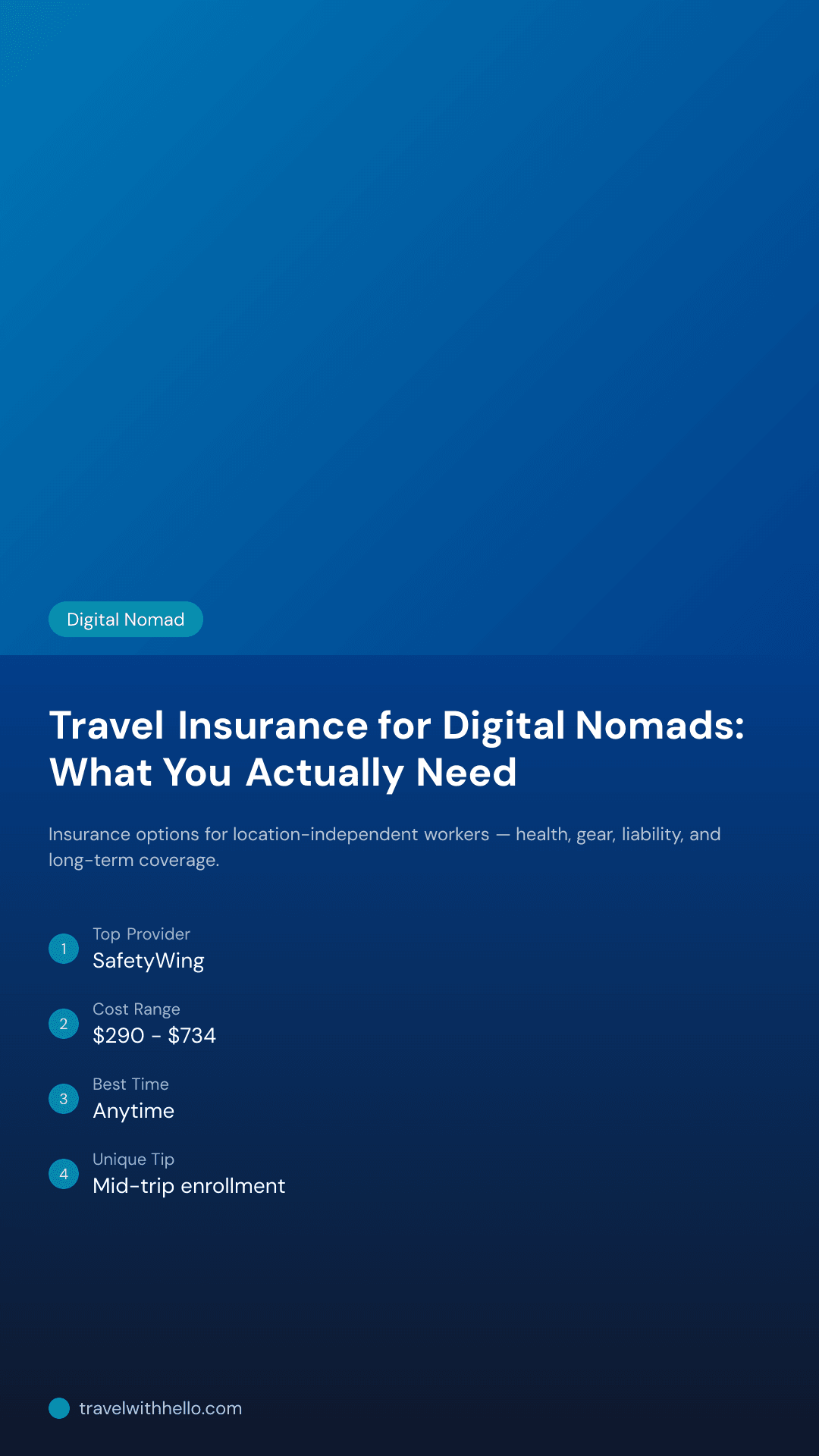
Travel Insurance for Digital Nomads: What You Actually Need
Insurance options for location-independent workers — health, gear, liability, and long-term coverage.
By Hello Travel Team
TL;DR: The Digital Nomad Insurance You Actually Need
Digital nomad insurance should cover emergency healthcare, medical evacuation, personal liability, and the laptop or camera equipment your income depends on—not just trip cancellation. For a six-month stay in Japan, Thailand, or another remote-work base, choose long-term travel insurance that allows repeated country changes, covers remote work, and remains valid for your entire visa period. Japan’s digital nomad visa requires comprehensive international health insurance, while many visa programs expect proof of coverage before arrival, according to the Japan National Tourism Organization and visa guidance. A practical policy budget for 2026 is roughly $50–$180 per month, depending on age, nationality, deductible, destinations, and medical limits. Keep valuables documented, check exclusions carefully, and use Hello’s app to track insurance premiums alongside accommodation, coworking, and multi-currency travel spending.
Digital Nomad Insurance vs. Ordinary Travel Insurance
The best digital nomad insurance is designed for people who live abroad for months, change countries frequently, and continue working online; ordinary holiday insurance often assumes a short, fixed trip with a defined return date. Before buying, confirm that the policy allows remote work, one-way travel, multiple destinations, and renewals while you are already overseas. Japan welcomed a record 36.87 million international visitors in 2024, according to JNTO, and popular remote-work areas such as Tokyo, Osaka, Chiang Mai, Bangkok, and Lisbon can involve long stays rather than two-week holidays. Compare policies by what they pay, not only by the monthly premium. | Coverage type | What to look for | Typical practical limit | |---|---|---| | Emergency medical | Hospital treatment, surgery, prescriptions | At least $250,000; higher is better | | Evacuation | Transport to suitable care or home country | $100,000+ | | Personal liability | Accidental injury or property damage | $500,000+ | | Electronics | Theft, accidental damage, replacement value | Enough for your actual laptop and camera | | Trip interruption | Return home after serious illness or family emergency | Clear transport and accommodation limits | | Long-term validity | Renewal abroad and multiple countries | 6–12 months or longer | A low-priced plan with a $500 laptop limit will not protect a $2,000 MacBook. Treat health insurance, gear cover, and professional liability as separate checks, even when they appear in one package.
Health and Medical Evacuation Cover for Remote Workers
For most location-independent workers, health protection is the non-negotiable part of nomad travel insurance because one hospital admission or evacuation can cost more than a year of premiums. Choose a policy covering inpatient and outpatient care, emergency dental treatment, prescriptions, mental-health support where available, and medical evacuation. Check whether treatment must be pre-authorized and whether the insurer pays hospitals directly or expects reimbursement. Japan’s digital nomad visa is a six-month, non-renewable status, and JNTO advises applicants to arrange comprehensive international healthcare insurance for the full stay. Some visa guidance cites minimum medical coverage of ¥10 million, so request a certificate showing the amount, dates, and geographic validity before applying. In Thailand, a remote worker might pay around $15–$40 for a local clinic visit but substantially more for private-hospital treatment or air evacuation. A higher deductible can reduce monthly premiums, but keep enough emergency cash available. Confirm exclusions for pre-existing conditions, alcohol-related incidents, adventure activities, scooters, and treatment in the United States or Canada. If you plan to spend one month in Chiang Mai, three months in Bangkok, and two months in Tokyo, the policy should cover all three locations without requiring a new application at every border.
Laptop, Camera, Liability, and Remote Work Insurance
Your remote work insurance should protect the tools that generate income, but standard baggage cover is often too limited, excludes unattended electronics, or applies only while travelling between destinations. Make a dated inventory of your laptop, phone, camera, monitor, hard drives, and other equipment; save receipts, serial numbers, photos, and proof of ownership in encrypted cloud storage. Ask whether the policy covers accidental damage, theft from a locked accommodation, loss in transit, and equipment used for business. A separate business or professional-liability policy may be necessary if a client claims that your work caused financial loss, a recommendation that general travel insurance does not replace. Personal liability is different: it generally concerns accidental injury or property damage, such as damaging a coworking-space monitor or injuring someone while cycling. Coworking memberships can cost approximately $80–$250 per month in Chiang Mai, $150–$400 in Bangkok, and $200–$500 in Tokyo in 2026, so check whether rented equipment and shared-office incidents are excluded. Never assume a host’s insurance protects your belongings. Use a lock, avoid leaving devices unattended in cafés, and keep offline copies of emergency contacts, policy numbers, and your insurer’s claims procedure.
Long-Term Travel Insurance for Visas, Multiple Countries, and Connectivity
Long term travel insurance works best when it follows your lifestyle rather than a single itinerary: it should allow country changes, renewal from abroad, temporary visits home, and continuous remote work. Digital nomads commonly compare destinations by rent, internet reliability, coworking supply, visa rules, and community—not just weather. Tokyo offers excellent rail connections and consistently strong urban broadband but usually costs more than Chiang Mai; Chiang Mai has an established nomad community and lower living costs, while Bangkok offers more coworking options and international flights. Before booking a monthly apartment, test the building’s Wi-Fi, confirm backup power, and ask whether a private workspace is included. Carrying reliable mobile data is equally useful during arrival, outages, and train journeys. You can buy and activate Hello eSIM for Japan before departure and arrive connected, with Hello eSIM plans available across 200+ countries and instant activation. Hello is available through travelwithhello.com and its iOS and Android app. Check that your insurance remains valid if you work from cafés, coworking spaces, or rented apartments, and verify whether visa applications require a specific insurer, minimum limit, or wording on the certificate.
Common Questions About Digital Nomad Insurance
The right policy depends on your destination, visa, health history, work equipment, and how long you will remain abroad, but a few practical rules apply to nearly every digital nomad. Does regular travel insurance cover remote work? Sometimes, but many policies exclude business activity or cap equipment claims, so obtain written confirmation that online employment is permitted. Is health insurance mandatory for a digital nomad visa? Frequently. Japan’s six-month visa requires international medical insurance, and other programs may specify minimum limits, validity dates, or evacuation benefits. How much does nomad travel insurance cost? A reasonable 2026 planning range is $50–$180 per month for many healthy adults, although age, destination, pre-existing conditions, limits, and deductible can change the price substantially. Can I buy insurance after leaving home? Some long-term providers allow it, but waiting periods, claims for existing symptoms, and visa deadlines may apply. Should I insure my laptop separately? If replacing it would disrupt your income, yes—especially when the policy’s electronics limit is below its value. Do I need liability cover? It is worthwhile for anyone renting apartments, using coworking spaces, riding a scooter, or meeting clients in person. Read the exclusions before paying, and save the certificate somewhere accessible offline.
A Practical Insurance Checklist for Your Next Nomad Move
Before departure, buy coverage that matches the entire planned stay, then test the claims process and document everything you may need to prove. Start with your passport, visa dates, destination list, emergency contacts, prescriptions, vaccination records, and insurer certificate. Confirm the policy covers your nationality and country of residence, not merely the country you are visiting. Next, photograph each device, record serial numbers, and store receipts in cloud and offline copies. For a move to Japan, reserve accommodation with dependable internet near a train station, budget roughly $10–$25 for a casual meal in 2026, and compare coworking costs before committing to a neighborhood. For Thailand, retain a digital copy of your passport and check local scooter and driving requirements before renting. Track premiums, doctor visits, coworking fees, accommodation, and transport in Hello’s multi-currency budget tools: AI receipt scanning supports different languages and currencies, while voice entry, bank-statement import, automatic exchange rates, categorization, and expense splitting simplify life when friends travel together. A final pre-departure check should confirm: medical limit, evacuation, liability, electronics, deductible, exclusions, renewal rules, home-country visits, remote-work permission, and 24-hour assistance. The cheapest policy is rarely the best value if it cannot pay when you need it.
Stay connected wherever you go
Get an eSIM before you land. Hello gives you instant data in 200+ countries — no SIM swaps, no roaming fees.
Related Articles
Best WiFi Countries for Remote Work: Internet Speed Rankings
Countries ranked by internet speed, reliability, and mobile data coverage for remote workers.
6 July 2026
Managing Finances as a Digital Nomad: Multi-Currency Tips
Track expenses across countries, manage multiple currencies, and optimise your nomad budget.
5 July 2026
Cost of Living Comparison for Remote Workers: Top Nomad Cities
Compare living costs across popular digital nomad destinations — rent, food, transport, and coworking.
26 June 2026