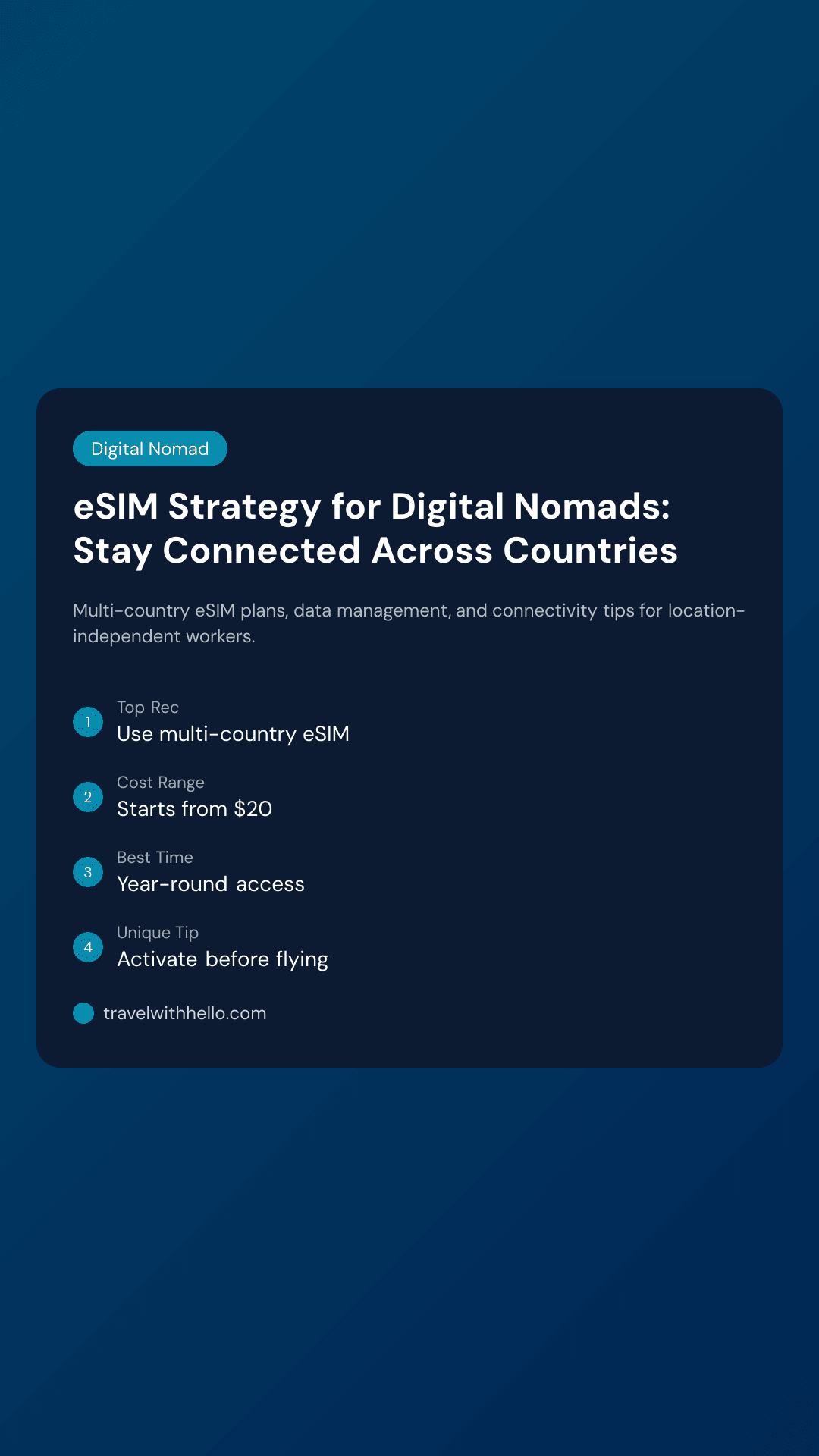
eSIM Strategy for Digital Nomads: Stay Connected Across Countries
Multi-country eSIM plans, data management, and connectivity tips for location-independent workers.
By Hello Travel Team
TL;DR: Build a Multi-Country eSIM Strategy Before You Leave
The simplest digital nomad eSIM strategy is to activate Hello before departure, estimate your monthly data use, and keep a backup connection plan for calls, travel days, and outages. Hello offers eSIM data plans across 200+ countries, with plans starting from 5GB and prices updated live, so you can cross borders without swapping physical SIM cards. Buy and activate an eSIM from Hello before your flight, then arrive connected for maps, ride-hailing, banking, and work messages. For a multi-country route such as Japan, Thailand, and Portugal, compare coverage, expected video-call use, and the number of days in each country rather than choosing only by price. Track accommodation, coworking, transport, and data spending in the Hello app using automatic exchange rates, AI receipt scanning, and multi-currency budgets.
How to Choose a Digital Nomad eSIM for Reliable Remote Work
Choose a digital nomad eSIM by prioritizing network reliability, activation timing, and enough high-speed data for video calls—not merely the cheapest headline price. Before purchasing Hello eSIM, list your likely work activities: email and messaging use little data, while daily video meetings, cloud backups, and hotspotting can consume several gigabytes each week. A practical remote-work target is at least 25 Mbps download for reliable video calls, although real-world performance depends on the local network, building materials, congestion, and weather. Hello’s plans cover 200+ countries, making them useful for multi-country itineraries where changing physical SIMs would be inconvenient. Activate before departure, but check your phone is unlocked and eSIM-compatible. Keep your primary SIM available for incoming texts if necessary, while setting Hello as the mobile-data line. Disable automatic app updates, photo backups, and video autoplay over cellular data. In Japan, test the connection before leaving Tokyo’s airport or station; in Thailand, keep a second work location available during storms or local network congestion. For country-specific planning, see Hello eSIM for Japan.
Multi-Country eSIM Planning for Japan, Thailand, and Europe
A multi country eSIM works best when your route is planned around border crossings, data resets, and work-critical travel days rather than treating every destination as identical. Consider this sample 30-day route: 10 days in Tokyo, 10 days in Chiang Mai, and 10 days in Lisbon. Tokyo offers excellent transport connectivity and dependable urban networks, but accommodation and coworking costs are usually higher. Chiang Mai is popular for its lower costs and established nomad community; current 2026 estimates put a comfortable monthly budget around $800–$1,300, with coworking often about $70–$100 per month. Lisbon has strong infrastructure and community events but commonly requires a larger housing budget. Japan welcomed more than 31 million international visitors in 2024, according to the Japan National Tourism Organization, so popular districts and trains can be busy during peak periods. Buy one Hello plan covering the countries you will actually visit, or combine destination plans when that produces clearer data limits and better value. Save offline maps, boarding passes, and accommodation details before each move. Confirm visa rules separately: Thailand’s Destination Thailand Visa and Japan’s digital nomad visa have eligibility, income, insurance, and stay requirements that change, so consult official immigration sources before booking.
Internet Speed, Coworking Costs, and Work-Friendly City Budgets
Your real remote-work budget combines housing, coworking, backup connectivity, meals, and transport; a fast connection is valuable only when you can access it consistently. In Chiang Mai, a studio in Nimman may cost roughly $300–$500 per month, while a coworking membership commonly runs about $70–$100, according to 2026 destination estimates. Thailand’s average fixed broadband download speed was reported at 237.05 Mbps in 2025 through the Ookla Speedtest Global Index, although apartment Wi-Fi and mobile performance can differ significantly. Use coworking spaces for important presentations and cafés for lighter tasks, observing local etiquette: purchase something, avoid occupying peak seats for hours, and use headphones. In Tokyo, coworking day passes may cost approximately ¥1,500–¥4,000 ($10–$27) in 2026, while Lisbon day passes often fall near €15–€30 ($17–$35). A Hello eSIM provides mobile-data flexibility when café Wi-Fi is crowded or accommodation internet fails, but it should complement—not replace—testing the actual workspace. Ask about upload speed, private call booths, power outlets, generator coverage, and whether phone calls are acceptable. Budget separately for coworking, because a low-rent apartment with unreliable Wi-Fi can cost more in lost work time.
Data Management and Nomad Connectivity Habits That Save Money
The most effective nomad connectivity habit is to reserve mobile data for mobility and emergencies while using trusted fixed Wi-Fi for large transfers and long meetings. At the start of each month, estimate your data needs and create a simple allowance: 5–10GB for light work, 15–30GB for regular video meetings, and more if you hotspot a laptop daily. Hello plans start from 5GB, with live pricing that can change by destination and plan size. Check your phone’s data counter weekly and set a warning at 75% of your allowance. Download Netflix episodes, podcasts, maps, translation packs, and large work files over secure Wi-Fi. Turn off cloud photo synchronization while roaming, restrict background refresh, and disable automatic operating-system updates until you reach reliable Wi-Fi. Use a laptop hotspot only when essential because video conferencing and software updates can consume data quickly. For security, avoid entering banking credentials on open café networks, use a VPN approved by your employer, and enable multi-factor authentication before leaving home. In rural Thailand, islands, or mountain areas, download directions and keep cash available because connectivity and card acceptance can vary.
Visa Rules, Cost of Living, and Building a Nomad Community
A successful location-independent lifestyle balances legal stay limits, predictable monthly costs, and a community where you can find professional support quickly. Digital nomad visa programs differ widely: some require proof of income, health insurance, accommodation, and a clean record, while others permit only limited remote work for foreign employers. Treat visa eligibility as a pre-booking checklist, and verify requirements with the destination’s immigration authority because income thresholds and application procedures can change during 2026. For budgeting, current estimates place Chiang Mai around $800–$1,300 per month for a comfortable lifestyle, while Lisbon can exceed $2,000 depending on rent and neighborhood. Use coworking communities for workshops, language exchanges, founder meetups, and referrals to accountants or immigration advisers. In Tokyo, look around Shibuya, Shinjuku, and Kanda for workspaces and transport convenience; in Chiang Mai, Nimman is the easiest starting point for cafés, coworking, and international networking. Join community events respectfully: introduce yourself, avoid treating every conversation as a sales opportunity, and follow local customs such as removing shoes where requested. Hello’s budget tracking can combine accommodation, meals, transport, and coworking in multiple currencies, making it easier to compare whether moving cities actually reduces your monthly costs.
Common Questions About Digital Nomad eSIMs and Remote Work Internet
Most nomads can stay productive with Hello eSIM, a dependable workspace, and offline backups, but the right setup depends on how often they cross borders and how heavily they use video or hotspot data.
How early should I buy an eSIM? Buy an eSIM from Hello before departure so you can install it while connected to home Wi-Fi and activate it according to the plan’s instructions. Confirm your phone is unlocked and compatible first.
Is 5GB enough for remote work? It may cover light email, messaging, maps, and occasional calls. Frequent video meetings, cloud work, or laptop hotspot use can require 15–30GB or more per month, so review your phone’s historical usage.
Can I use one plan across several countries? Hello offers plans for 200+ countries, making multi-country travel simpler, but always check the exact destination list, validity period, supported networks, and data allowance before purchase.
Do I still need coworking Wi-Fi? Usually, yes. A coworking space provides stable power, ergonomic seating, and better conditions for important calls; Hello mobile data is valuable for commuting, arrival days, and outages.
How can I control travel expenses? The Hello app supports AI receipt scanning in any language or currency, voice expense entry, CSV/PDF bank-statement import, automatic exchange rates, AI categorization, and expense splitting with friends across multiple currencies. It is available through travelwithhello.com, the App Store, and Google Play.
Stay connected wherever you go
Get an eSIM before you land. Hello gives you instant data in 200+ countries — no SIM swaps, no roaming fees.
Related Articles
Travel Insurance for Digital Nomads: What You Actually Need
Insurance options for location-independent workers — health, gear, liability, and long-term coverage.
14 July 2026
Best WiFi Countries for Remote Work: Internet Speed Rankings
Countries ranked by internet speed, reliability, and mobile data coverage for remote workers.
6 July 2026
Managing Finances as a Digital Nomad: Multi-Currency Tips
Track expenses across countries, manage multiple currencies, and optimise your nomad budget.
5 July 2026