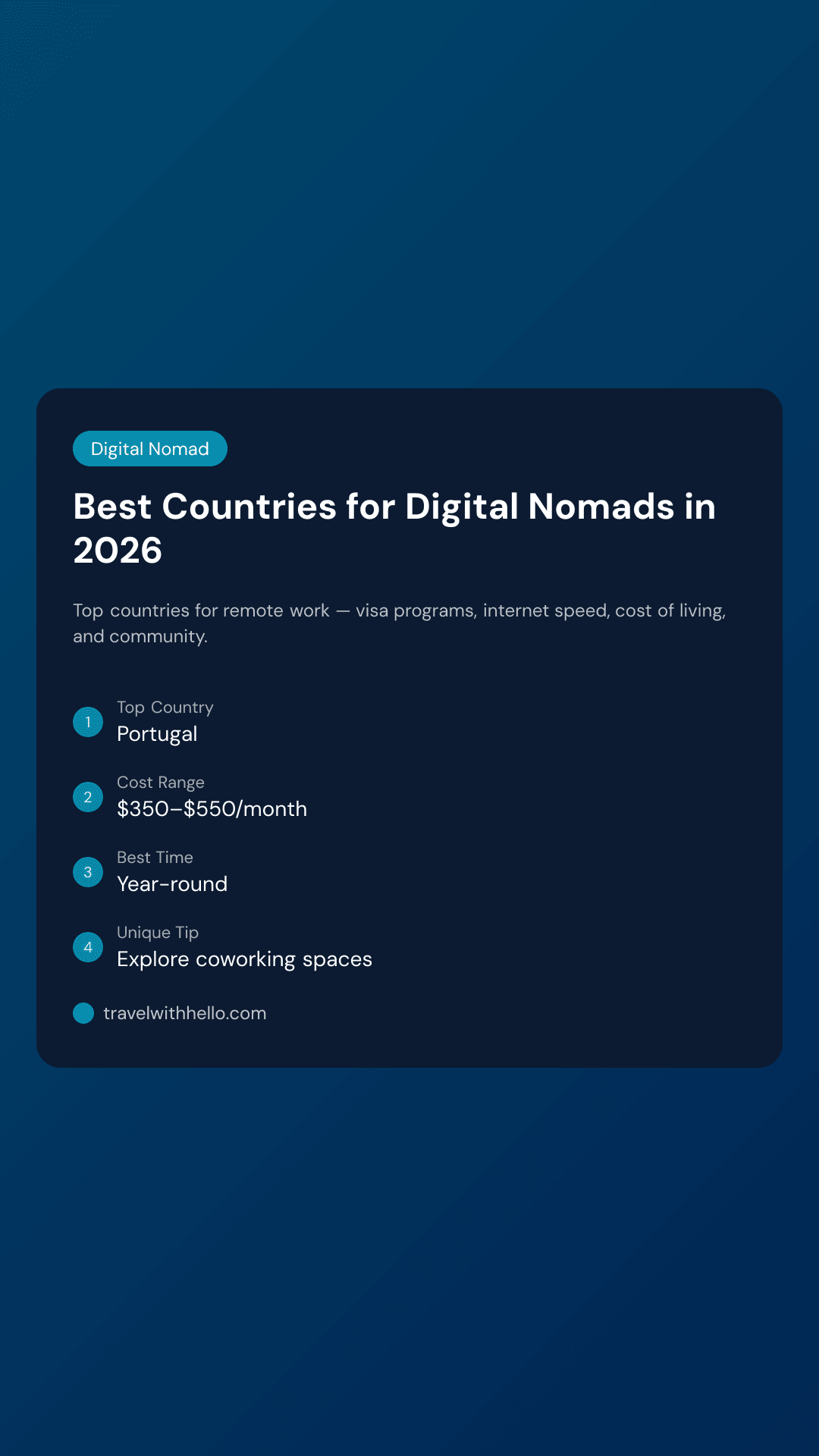
Best Countries for Digital Nomads in 2026
Top countries for remote work — visa programs, internet speed, cost of living, and community.
By Hello Travel Team
TL;DR: Best Countries for Digital Nomads in 2026
The best countries for digital nomads in 2026 combine dependable internet, practical visa options, manageable monthly costs, and an active international community. Portugal, Thailand, Mexico, Spain, Estonia, Indonesia, Georgia, and the United Arab Emirates stand out for different budgets and lifestyles. Portugal and Spain suit European time zones, Thailand and Indonesia offer strong communities at lower daily costs, while Estonia and the UAE appeal to founders and higher-earning professionals.
For a comfortable solo lifestyle in 2026, budget approximately $1,400–$2,800 per month in Chiang Mai, $1,800–$3,500 in Lisbon, $1,500–$3,000 in Mexico City, and $2,500–$5,000 in Dubai. Your final choice should also reflect tax rules, seasonality, flight connections, and how often you need to work on video calls.
Best Remote Work Countries Compared: Cost, Internet, Visas, and Community
The strongest remote work countries are not always the cheapest; they are the places where fast connectivity, legal stay options, coworking access, and everyday convenience work together. The following comparison gives a practical 2026 starting point for planning.
| Country | Typical solo monthly budget in 2026 | Internet snapshot | Visa or stay option | Best for |
|---|---|---|---|---|
| Portugal | $1,800–$3,500 | Around 110 Mbps in browser tests | Digital nomad residence visa | Europe, surf, established community |
| Thailand | $1,200–$2,800 | Up to about 280 Mbps fixed median | Long-Term Resident and other options | Value, food, coworking |
| Mexico | $1,500–$3,000 | Around 78 Mbps average fixed download | Temporary Resident Visa | Americas time zones |
| Spain | $2,000–$3,800 | Around 278 Mbps fixed median | Digital nomad visa | Cities, culture, EU access |
| Indonesia | $1,300–$3,000 | Around 42 Mbps average fixed download | Remote-worker and longer-stay options | Bali lifestyle and community |
| Estonia | $1,700–$3,200 | Strong urban broadband | Digital Nomad Visa | Startups and digital government |
| Georgia | $1,000–$2,200 | Variable by city and building | Accessible remote-worker routes | Low costs and flexibility |
| UAE | $2,800–$6,000 | About 385 Mbps fixed and 645 Mbps mobile median | Remote Work Visa | Premium infrastructure and business |
Speed figures vary by provider, neighborhood, and measurement method. SpeedOf.Me places Portugal at roughly 110 Mbps in real-world browser tests, while 2026 fixed-network rankings report Thailand near 280 Mbps and the UAE near 385 Mbps. Treat these figures as national indicators, not a guarantee for a particular apartment.
Portugal, Spain, and Estonia: Europe’s Best Digital Nomad Destinations 2026
Portugal, Spain, and Estonia are excellent European choices when you want reliable infrastructure, walkable cities, legal remote-work pathways, and easy access to neighboring countries. They are especially practical for freelancers and employees serving European or African clients because time-zone overlap is excellent.
Portugal remains a popular base in Lisbon, Porto, Madeira, and the Algarve. A one-bedroom apartment outside central Lisbon may cost $1,000–$1,700 monthly in 2026, while coworking desks commonly range from $150–$300. Lisbon’s neighborhoods are social and international, but summer accommodation prices rise sharply. Madeira offers a smaller, outdoors-focused community and the well-known Ponta do Sol nomad scene.
Spain’s digital nomad visa is attractive for eligible non-EU remote workers, with income requirements and documentation that should be checked with the Spanish consulate before applying. Madrid, Barcelona, Valencia, Málaga, and Las Palmas each offer coworking spaces, meetups, and good public transport. Expect roughly $2,000–$3,800 monthly for a comfortable solo setup, depending heavily on rent.
Estonia suits startup operators who value digital administration and a compact, tech-oriented community. Tallinn is more expensive than Southeast Asia but efficient, with typical coworking memberships around €150–€250 per month. Apply early, keep certified documents organized, and verify tax residency implications before staying long-term.
Thailand and Indonesia: Affordable Digital Nomad Countries With Strong Communities
Thailand and Indonesia are among the best countries for digital nomads who prioritize affordable living, excellent food, warm weather, and large communities that make networking easy. They offer the most lifestyle value when you choose the right city and season rather than simply the cheapest accommodation.
Chiang Mai is the classic budget base: a comfortable solo nomad may spend $1,200–$2,000 per month, with coworking memberships often around $80–$180. Nimman is convenient for cafés, gyms, apartments, and meetups, although Chiang Mai’s burning season—typically strongest from February through April—can affect air quality. Bangkok offers better international flights, nightlife, and corporate networking, but usually costs $1,800–$3,000 monthly.
Bali’s Canggu and Ubud provide yoga, wellness, founder events, and a dense international network. A realistic 2026 budget is $1,500–$3,000 monthly; rent can rise substantially during peak periods, and traffic makes neighborhood choice important. Indonesia’s internet is generally adequate for ordinary work, but test the exact accommodation and keep a backup connection for important calls.
Before arrival, review visa rules carefully because tourist permission, business activity, and remote work for an overseas employer may be treated differently. Learn local etiquette, dress more modestly when visiting temples, and avoid working noisily in cafés during busy hours.
Mexico and Georgia: Flexible, Social Remote Work Countries for Different Budgets
Mexico and Georgia are strong choices for nomads who want generous social scenes, relatively accessible entry arrangements, and lower costs than much of Western Europe. Mexico is better for North American working hours, while Georgia is particularly appealing to independent workers seeking flexibility and a low-cost base.
Mexico City supports a broad professional network across Roma Norte, Condesa, Juárez, and Polanco. A solo nomad can often plan on $1,500–$3,000 monthly in 2026, with coworking desks around $120–$250 and inexpensive local meals available far below restaurant prices in tourist districts. Oaxaca, Mérida, Playa del Carmen, and Puerto Vallarta offer different balances of culture, climate, and community. Check immigration rules and avoid assuming that repeated tourist entries create a lawful long-term work arrangement.
Tbilisi is one of the most affordable capital-city options, with a practical monthly budget around $1,000–$2,200. The city has cafés, shared offices, wine bars, and a welcoming international scene; Batumi offers a warmer coastal alternative. Georgia’s remote-worker pathways are often considered accessible, but eligibility and tax treatment can change.
In both countries, inspect apartment internet before paying a deposit, confirm heating or air-conditioning costs, and use coworking spaces for client calls when home connections are uncertain.
Connectivity, Coworking, and Daily Logistics for Nomads in 2026
The most reliable nomad setup uses fast home internet, a coworking backup, and mobile data that is active before landing, so one outage never becomes a missed meeting or delayed deliverable. Internet speed matters, but stability, upload performance, power reliability, and latency matter just as much for video calls and cloud work.
Choose accommodation with a recent speed test, ask whether the connection is private or shared, and check upload speed rather than relying only on a headline download number. A desk in a reputable coworking space commonly costs $80–$300 per month across lower- and mid-cost destinations; day passes generally range from $8–$25. In Dubai, Lisbon, and central Barcelona, premium memberships can exceed $300.
Before flying, install Hello eSIM for your destination and activate a plan from Hello before departure. Hello offers eSIM data plans for 200+ countries, with plans starting from 5GB and prices updated live, so you can arrive connected without swapping physical SIM cards. Use it for maps, ride-hailing, two-factor authentication, hotspot backup, and checking in with clients while you arrange a local workspace.
The Hello app also supports multi-currency budget tracking, AI receipt scanning in different languages and currencies, voice expense entry, bank-statement imports, and automatic categorization. That is useful when rent, coworking, transport, and meals appear in several currencies during one month.
Common Questions About the Best Countries for Digital Nomads in 2026
The best country depends on your budget, passport, client time zone, preferred climate, and tolerance for visa administration. A destination that is ideal for a $1,500 monthly lifestyle may be frustrating for someone who needs premium housing, dependable power, or frequent same-day access to European or North American clients.
Which country is cheapest for digital nomads in 2026? Georgia and northern Thailand are among the most affordable options with established international communities. A careful solo worker may manage on approximately $1,000–$2,200 per month in Tbilisi or $1,200–$2,000 in Chiang Mai, excluding major flights and international insurance.
Where is the fastest internet? The UAE is a standout in 2026 fixed and mobile speed rankings, with reported medians near 385 Mbps fixed and 645 Mbps mobile. Thailand and Spain also score strongly on fixed broadband. Actual performance still depends on the building, provider, Wi-Fi router, and local congestion.
What is the best country for first-time nomads? Portugal or Thailand is usually the easiest starting point because both have mature communities, abundant coworking options, and straightforward day-to-day logistics in major hubs. Start with a one-month rental before committing to a long lease.
Do digital nomad visas remove tax obligations? No. A visa governs immigration status, while tax residence and employer obligations may follow separate rules. Get professional advice before crossing relevant day-count thresholds or signing a local contract.
How should nomads manage group expenses? The Hello app can split expenses across multiple currencies, apply automatic exchange rates, and track shared costs, making it practical for coliving, coworking groups, and multi-country trips.
Stay connected wherever you go
Get an eSIM before you land. Hello gives you instant data in 200+ countries — no SIM swaps, no roaming fees.
Related Articles
Travel Insurance for Digital Nomads: What You Actually Need
Insurance options for location-independent workers — health, gear, liability, and long-term coverage.
14 July 2026
Best WiFi Countries for Remote Work: Internet Speed Rankings
Countries ranked by internet speed, reliability, and mobile data coverage for remote workers.
6 July 2026
Managing Finances as a Digital Nomad: Multi-Currency Tips
Track expenses across countries, manage multiple currencies, and optimise your nomad budget.
5 July 2026