Travel Budget Planning: How to Plan Your Trip Finances
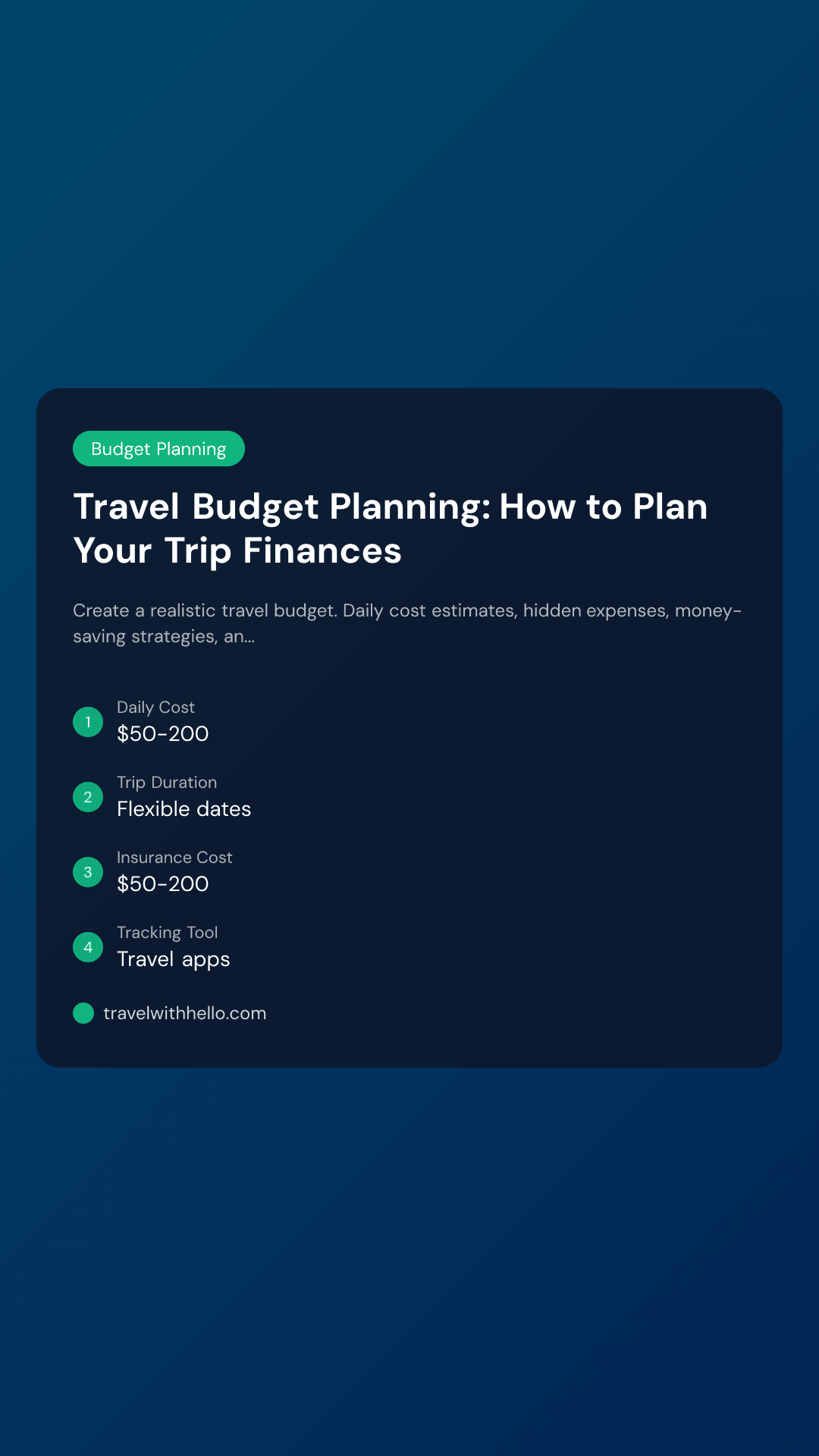
Create a realistic travel budget. Daily cost estimates, hidden expenses, money-saving strategies, and tools to track spending on the go.
By Hello Travel Team
TL;DR: Travel Budget Planning at a Glance
A realistic travel budget combines fixed costs—flights, visas, insurance, and accommodation—with daily spending for food, transport, activities, and a 10–15% emergency buffer. For 2026, a budget traveller might spend about $70–$120 per day excluding international flights, while mid-range travel often requires $150–$250 per day, depending on the destination and season. A trip budget calculator or spreadsheet can turn those estimates into a practical savings target.
Before booking, decide your travel style, trip length, destinations, and must-do experiences. Track spending in the local currency as you go, account for exchange-rate changes and card fees, and review your total every few days. Hello’s budget-tracking tools can scan receipts in different languages and currencies, import bank statements, categorize expenses with AI, and split shared costs automatically.
How to Build a Realistic Travel Budget From the Ground Up
The most reliable way to budget for travel is to separate one-time trip costs from daily spending, then add a buffer for price changes, unexpected transport, and small purchases that are easy to overlook. Start with the number of travellers and nights, because accommodation and shared transfers can change dramatically when costs are divided.
Use this structure:
- Pre-trip costs: flights, visas, travel insurance, vaccinations, luggage, airport transfers, and advance bookings.
- Accommodation: nightly rate multiplied by nights, plus city taxes, resort fees, cleaning charges, or breakfast supplements.
- Daily costs: meals, local transport, attractions, shopping, tips, and drinks.
- Connectivity: budget for a reliable data plan so you can use maps, translation, transport apps, and mobile payments.
- Contingency: add 10–15% of the estimated total, or more for remote destinations and multi-country itineraries.
For example, a 10-day mid-range trip could include $900 for flights, $1,000 for accommodation, $700 for food and local transport, $400 for activities, $100 for insurance and connectivity, and a $300 buffer—about $3,400 overall. Entering each category into a trip budget calculator makes it easier to see which changes—fewer hotel nights, slower travel, or fewer paid attractions—will have the biggest effect.
Daily Travel Costs: Budget, Mid-Range, and Comfortable Examples
Daily travel costs depend more on accommodation, destination, and transport style than on trip length, but travellers can use broad tiers to create an initial estimate before checking current prices. In 2026, budget travel commonly falls around $70–$120 per person per day excluding international flights, while mid-range travel is often about $150–$250 per day.
| Travel style | Accommodation | Food | Transport and activities | Typical daily total |
|---|---|---|---|---|
| Budget | $20–$60 | $15–$35 | $15–$30 | $70–$120 |
| Mid-range | $80–$180 | $35–$80 | $35–$70 | $150–$250 |
| Comfortable | $200+ | $80+ | $75+ | $350+ |
Destination examples help refine the estimate. A 2026 Japan budget guide places budget daily spending around ¥6,000–¥10,000, mid-range spending around ¥15,000–¥25,000, and comfortable travel at ¥30,000–¥50,000 or more. In Tokyo and Kyoto, accommodation and intercity rail can push totals upward; convenience-store breakfasts, casual ramen, and local trains can keep them manageable.
In Thailand, street-food meals may cost roughly $2–$5, while a mid-range restaurant meal may be $8–$20 in 2026. Island ferries, domestic flights, and private transfers can make a beach itinerary significantly more expensive than a city-based trip.
Hidden Travel Expenses That Can Break Your Trip Budget
The expenses most likely to disrupt a trip budget are not usually the headline costs; they are taxes, fees, transfers, exchange-rate losses, and small convenience purchases repeated every day. Add these items before booking rather than treating them as surprises.
Common overlooked costs include:
- Airport transfers: A cheap flight can become expensive when the airport is far from the city. Tokyo’s Narita Airport, for example, requires a longer train or bus journey than centrally located Haneda.
- City and accommodation taxes: Some destinations add nightly lodging taxes or mandatory resort charges at checkout.
- Baggage and seat fees: Compare the complete airline price, including checked luggage and seat selection.
- Transport supplements: A rail pass may not cover every express train, reserved seat, ferry, or local connection. One Tokyo–Kyoto Hikari Shinkansen fare is commonly around ¥13,320 one way in 2026.
- Cash and card costs: ATM fees, foreign transaction fees, dynamic currency conversion, and unfavourable exchange rates can add up.
- Connectivity: Roaming charges can be unpredictable. Buying and activating Hello eSIM for Japan before departure lets you arrive with data for maps, translation, bookings, and transport information.
- Cultural costs: In Japan, some restaurants charge a seating fee; in Thailand, tipping is not always required but is appreciated for good service.
Reserve at least 10% for these variable costs, and keep a separate emergency fund that is not included in your daily spending target.
Travel Money Tips and Strategies to Save Without Missing Out
The most effective travel money tips are to reduce expensive decisions, not to eliminate every enjoyable experience: travel in shoulder season, stay near efficient transport, eat locally, and reserve money for the activities you value most. A flexible itinerary often saves more than extreme daily restrictions.
Try these practical strategies:
- Set a weekly spending ceiling: Divide your total discretionary budget by the number of days, then leave a separate amount for major activities.
- Use a two-meal strategy: Have one inexpensive local meal—such as a ¥600–¥1,000 convenience-store bento or casual noodle meal in Japan—and spend more on one memorable meal.
- Slow down: Fewer hotel changes reduce baggage storage, taxis, laundry, and last-minute booking costs.
- Compare attraction bundles carefully: A pass is worthwhile only if the included attractions match your plans and the transport covered is useful.
- Choose free experiences: Tokyo neighbourhood walks, Bangkok markets, public parks, temples, beaches, and museum-free days can balance paid excursions.
- Keep payment options separate: Carry a small amount of local cash, one primary card, and one backup card stored separately.
- Check exchange rates before paying: Decline dynamic currency conversion when a card terminal offers to charge you in your home currency.
For group trips, Hello can split expenses across multiple currencies with automatic exchange-rate conversion, helping friends settle costs without creating a confusing spreadsheet.
How to Track Spending on the Go With a Trip Budget Calculator
The easiest way to stay within a travel budget is to record every purchase immediately, review category totals every few days, and compare actual spending with your remaining daily allowance. Waiting until the end of a trip makes it difficult to identify whether restaurants, taxis, shopping, or activities caused the overspend.
Create categories before departure: accommodation, food, transport, attractions, shopping, connectivity, fees, and miscellaneous. Record the amount in the local currency and let your tracker convert it into your planning currency. This matters on multi-country trips, where mental conversions can hide small losses.
A simple calculation is:
Remaining daily budget = (total budget − spending so far − committed future costs) ÷ days remaining
If you planned $1,200 for daily expenses and have spent $450 after five days, with five days left, your remaining average is $150 per day. If a $250 excursion is already booked, subtract it first; otherwise, the calculation gives a falsely optimistic result.
Hello’s app supports AI receipt scanning in different languages and currencies, voice expense entry, CSV or PDF bank-statement imports, automatic categorization, and multi-currency tracking. Those features are useful in places such as Japan, where receipts may be printed in Japanese and purchases can involve cash, cards, transit cards, and mobile payments. Review entries while connected through Hello’s eSIM plans, which support travel data in 200+ countries with prices updated live.
Common Questions About How to Budget for Travel
Travellers usually budget successfully by estimating fixed costs first, setting a realistic daily allowance second, and adding a contingency fund rather than relying on an unrealistically low average. The right figure depends on destination, season, accommodation, transport, and the experiences that matter most to you.
How much should I budget for a seven-day trip? Excluding international flights, a reasonable 2026 starting range is about $490–$840 for a budget traveller and $1,050–$1,750 for mid-range travel. Add accommodation, activities, insurance, connectivity, and a 10–15% contingency if they are not included in your daily estimate.
What is the best way to calculate a trip budget? List fixed costs, multiply expected daily spending by the number of days, add planned activities, and include a buffer. A trip budget calculator is especially useful for comparing scenarios such as hostels versus hotels or trains versus domestic flights.
How much emergency money should I take? Keep 10–15% of the trip total available for delays, medical costs, replacement documents, unexpected accommodation, or transport changes. Do not count this reserve as spending money.
Should I carry cash or use cards abroad? Use both. Cash remains useful for small restaurants, markets, temple donations, transport top-ups, and rural areas, while cards provide convenience and transaction records. Keep backup payment methods separate from your main wallet.
How can friends split travel expenses fairly? Record each payment, identify who benefited, and convert currencies using the same rate. Hello’s expense-splitting feature supports multiple currencies and automatic conversion, which is helpful when one person pays for a group meal or hotel deposit.
Track every dollar of your trip
Split expenses with friends, track spending by category, and see real-time currency conversions — all in one app.
Related Articles
Monaco Travel Budget Guide: Daily Costs and Money Tips
How much does it cost to travel in Monaco? Daily budget breakdowns for budget, mid-range, and luxury travellers.
29 May 2026

Zimbabwe Travel Budget Guide: Daily Costs and Money Tips
How much does it cost to travel in Zimbabwe? Daily budget breakdowns for budget, mid-range, and luxury travellers.
12 May 2026

Zambia Travel Budget Guide: Daily Costs and Money Tips
How much does it cost to travel in Zambia? Daily budget breakdowns for budget, mid-range, and luxury travellers.
12 May 2026