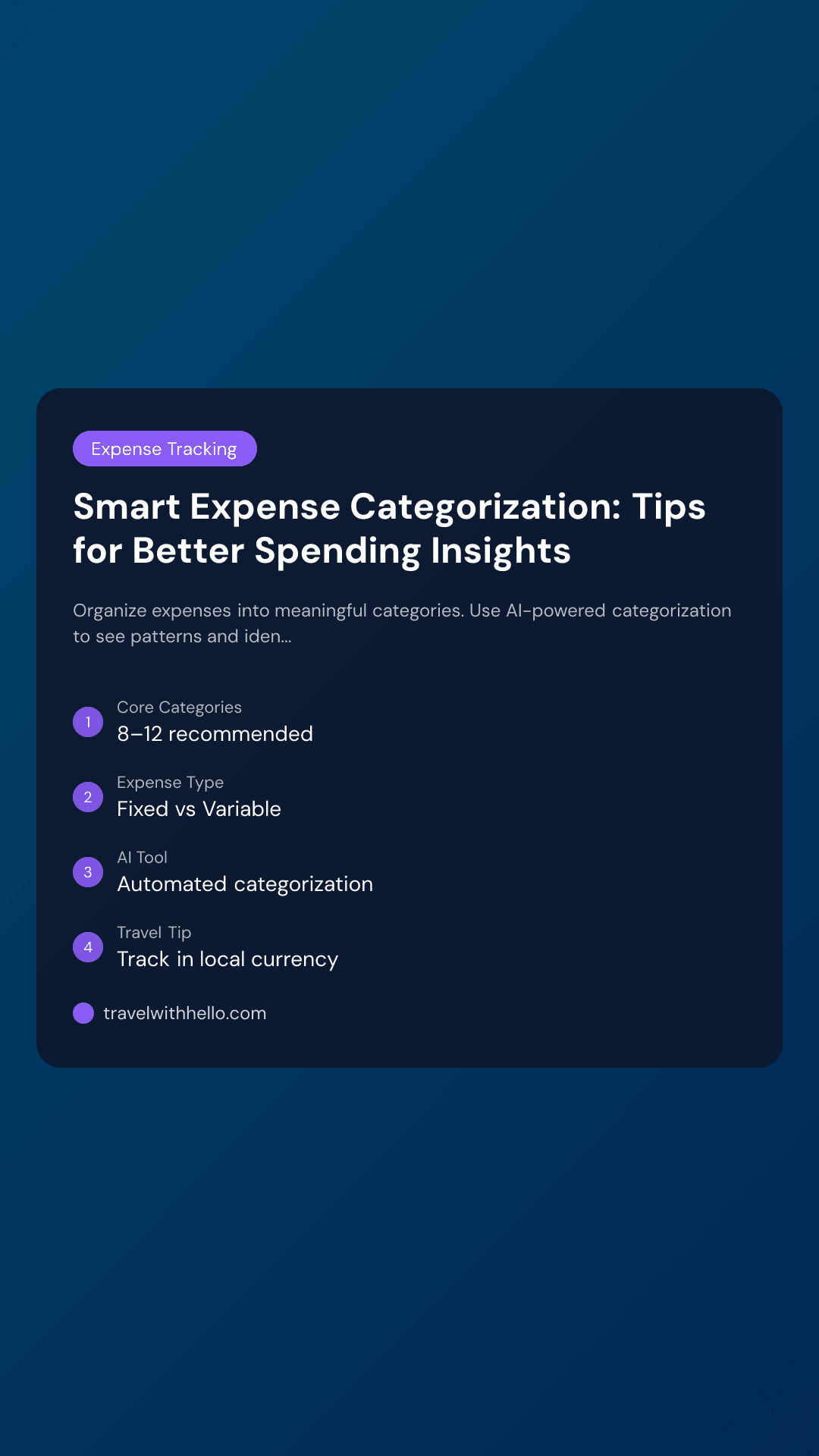
Smart Expense Categorization: Tips for Better Spending Insights
Organize expenses into meaningful categories. Use AI-powered categorization to see patterns and identify areas to save money.
By Hello Travel Team
TL;DR: Build Spending Categories That Explain Your Money
Smart expense categorization turns a long list of transactions into useful spending insights. Create a small set of consistent categories, review them weekly, and use AI-powered tools to categorize receipts, bank statements, and voice entries faster. For travellers, separating transport, meals, accommodation, activities, connectivity, and shared costs makes it easier to spot overspending before the trip budget disappears.
The best system is detailed enough to support decisions but simple enough to maintain. Hello helps by scanning receipts in any language or currency, importing CSV or PDF bank statements with AI categorization, converting currencies using live exchange rates, and splitting shared expenses with friends.
How to Create Practical Spending Categories for Better Expense Tracking
The most effective spending categories reflect decisions you regularly make, such as whether to cook, dine out, take taxis, or book more expensive accommodation. Start with eight to twelve broad categories, then add subcategories only when the extra detail helps you change behaviour.
A practical personal budget might include:
- Housing: rent, mortgage, utilities, and maintenance
- Food: groceries, restaurants, coffee, and delivery
- Transport: fuel, public transit, taxis, parking, and flights
- Health: insurance, prescriptions, appointments, and fitness
- Lifestyle: entertainment, shopping, hobbies, and subscriptions
- Financial: fees, interest, savings, and debt payments
- Travel: accommodation, activities, visas, insurance, and connectivity
- Shared: expenses awaiting reimbursement from friends or family
Avoid categories such as “miscellaneous” unless they are temporary. A large miscellaneous total hides patterns and makes your budget less actionable. For example, classify a ¥1,200 ramen meal in Japan as Food > Dining out, a ¥500 convenience-store breakfast as Food > Travel meals, and a train ticket as Transport > Public transit. JNTO reported 36.9 million international visitors to Japan in 2024, so destination spending can quickly become a meaningful part of many household budgets.
Categorize Expenses Consistently With AI, Receipts, and Bank Statements
AI expense categorization saves time by identifying merchants, currencies, and likely categories, but a quick human review keeps your spending data accurate enough for real decisions. Consistency matters more than perfect detail: the same type of purchase should land in the same category every time.
Use a three-step workflow:
- Capture the expense immediately with a receipt scan, voice entry, or bank import.
- Review the suggested category and correct unusual items.
- Check your category totals once a week and adjust future spending.
Hello’s AI receipt scanning works with any language or currency, which is useful when a Japanese receipt, Thai restaurant bill, or foreign-language supermarket ticket is mixed with domestic purchases. Voice entry can be as simple as saying, “coffee three dollars.” For older transactions, import a CSV or PDF bank statement and let AI suggest categories in bulk.
Set rules for recurring merchants. A monthly streaming service should always be Entertainment or Subscriptions, while a department-store purchase may need review because it could be groceries, clothing, or a gift. Also check duplicate imports, refunds, tips, and transaction fees so your category totals represent what you actually spent.
Use a Travel-Friendly Expense Categorization System Across Currencies
For international trips, track the original amount and your home-currency value so exchange-rate changes do not disguise the real cost of meals, transport, or shopping. Separate trip expenses from everyday spending, then use subcategories that match the decisions you make while travelling.
A useful travel structure looks like this:
| Category | Example | Why it helps |
|---|---|---|
| Accommodation | Hotel in Kyoto, $120 per night | Shows whether lodging is driving the budget |
| Transport | Shinkansen, metro, taxi | Identifies costly routing choices |
| Meals | Ramen, café, izakaya | Reveals dining patterns |
| Activities | Museum, temple donation, tour | Helps compare experiences by value |
| Shopping | Souvenirs, clothing, electronics | Prevents impulse purchases from blending into meals |
| Connectivity | Data plan or roaming-related cost | Keeps essential travel services visible |
| Shared expenses | Dinner paid for a group | Makes reimbursements easier |
Hello supports multi-currency tracking with automatic exchange-rate conversion, so a ¥4,000 dinner and a €35 museum ticket can be viewed alongside home-currency totals. Prices vary by destination: current Japan travel guides commonly place a standard ramen meal around ¥800–¥1,200, while premium dining can exceed ¥10,000 per person. Recording each purchase makes those differences visible instead of relying on memory.
Expense Tracking Tips That Reveal Where You Can Save
The fastest way to reduce spending is to compare categories against a target and investigate the largest repeated gap, rather than cutting every purchase indiscriminately. Review totals by week, merchant, payment method, and need so the data leads to a specific action.
Try these practical expense tracking tips:
- Identify your top three categories each month.
- Compare planned spending with actual spending, not just last month’s total.
- Divide flexible categories into essentials and optional purchases.
- Look for frequency: five small coffees can matter more than one unusual lunch.
- Set a travel-day limit, such as ¥5,000 for meals and local transport.
- Create a separate “fees and exchange” category to catch ATM charges and conversion costs.
- Review subscriptions quarterly and cancel services you have not used.
Imagine a seven-day Tokyo trip where meals average ¥3,500 per day, local transport averages ¥1,000, and activities average ¥2,000. The daily total is ¥6,500 before accommodation and shopping. If categorization shows ¥1,500 of daily food spending comes from cafés and snacks, replacing only half with a ¥500 convenience-store breakfast or set lunch can reduce the weekly total without eliminating restaurant meals. Current Japan budget guides list convenience-store meals at roughly ¥600–¥1,000, depending on what you buy.
Split Shared Expenses Without Losing the Category Detail
Shared expenses should remain categorized after splitting, because knowing who owes what is useful but knowing where the group spent money is what improves future decisions. Record the full transaction first, assign its category, then divide the amount among the people who benefited.
For example, one friend pays ¥18,000 for an izakaya dinner for three people. Categorize the full amount as Food > Group dining, then split it into three ¥6,000 shares. If one person did not drink alcohol, record separate food and drinks lines before splitting so the reimbursement is fair. The same approach works for a hotel room, airport taxi, attraction tickets, or a shared grocery run.
Hello’s expense splitting supports multiple currencies and automatic exchange-rate conversion. That is especially helpful when one traveller pays in Thai baht, another reimburses in euros, and everyone wants a clear home-currency balance. Add a note such as “Osaka dinner, March 2026” and mark the expense as settled once payment arrives.
Keep reimbursements separate from income. A repayment from a friend is not new earnings; it offsets the original shared expense. Treating it correctly prevents your monthly spending report from looking artificially high or your income report from becoming misleading.
Common Questions About Expense Categorization and Spending Categories
The best answers to common expense categorization questions are practical: use broad categories first, review AI suggestions, and add detail only when it changes a budgeting decision. A consistent system will produce more useful insights than a complicated one that you stop maintaining.
How many spending categories should I use? Start with eight to twelve main categories and no more than three or four subcategories each. Add a category when a spending pattern is large, recurring, or controllable.
Should coffee be groceries or dining out? Choose one rule and apply it consistently. If coffee is bought ready to drink, classify it as Dining out or Coffee; beans and home supplies belong in Groceries. Consistency makes comparisons meaningful.
Can AI categorize every transaction correctly? AI can make strong suggestions, but ambiguous merchants, refunds, cash withdrawals, and mixed-purpose stores require review. Check imported transactions before relying on monthly totals.
How should I categorize foreign purchases? Keep the original currency, use the transaction date, and view the converted home-currency amount. Hello’s live exchange-rate tracking helps compare purchases across countries.
What is the difference between an expense and a transfer? A purchase is an expense; moving money between your own accounts is a transfer. Categorizing transfers as spending can double-count your budget.
How often should I review categories? Capture expenses daily, review them weekly, and assess category targets at the end of each month. This rhythm catches errors while there is still time to adjust.
Turn Categorized Expenses Into a Repeatable Monthly Budget
Categorization becomes valuable when it leads to a clear next step: raise a limit, reduce a recurring cost, plan for a trip, or protect money for savings. End each month by reviewing category totals, identifying one successful choice, and selecting one realistic change for the next month.
Use this monthly review:
- Confirm that rent, bills, debt payments, and transfers were classified correctly.
- Compare essential and flexible spending.
- Investigate categories that exceeded their targets by more than 10%.
- Check refunds, reimbursements, subscriptions, and foreign-exchange fees.
- Set category limits for the next month using actual behaviour.
For an upcoming trip, create the budget before booking: accommodation, transport, meals, activities, shopping, insurance, and connectivity. If travelling to Japan, for example, a ¥1,000–¥1,500 daily breakfast-and-coffee allowance is very different from a ¥10,000 tasting menu, so separate everyday meals from special experiences. Travellers who need reliable data can arrange Hello eSIM for Japan before departure and place the cost under Travel > Connectivity.
Hello combines budget tracking with receipt scanning, voice entry, statement imports, multi-currency support, and group expense splitting. Used consistently, those tools turn scattered transactions into a simple feedback loop: record, categorize, review, and make one better spending decision.
Track every dollar of your trip
Split expenses with friends, track spending by category, and see real-time currency conversions — all in one app.
Related Articles
Best Expense Tracker Apps in 2026: Features Compared
Compare the top expense tracking apps. AI receipt scanning, bank import, splitting, voice entry, and multi-currency support.
6 July 2026
Personal Budget Planning: A Step-by-Step Guide for 2026
Create a personal budget that works. Set spending limits, track expenses by category, and build better financial habits.
5 July 2026
Multi-Currency Expense Tracking: Manage Money Across Countries
Track spending in any currency with automatic exchange rate conversion. See your total spending in your home currency at a glance.
26 June 2026