Maldives Currency & Money Guide: Exchange, Cards, and Tips
Currency exchange, credit card acceptance, ATM tips, tipping culture, and money-saving advice for Maldives.
By Hello Travel Team
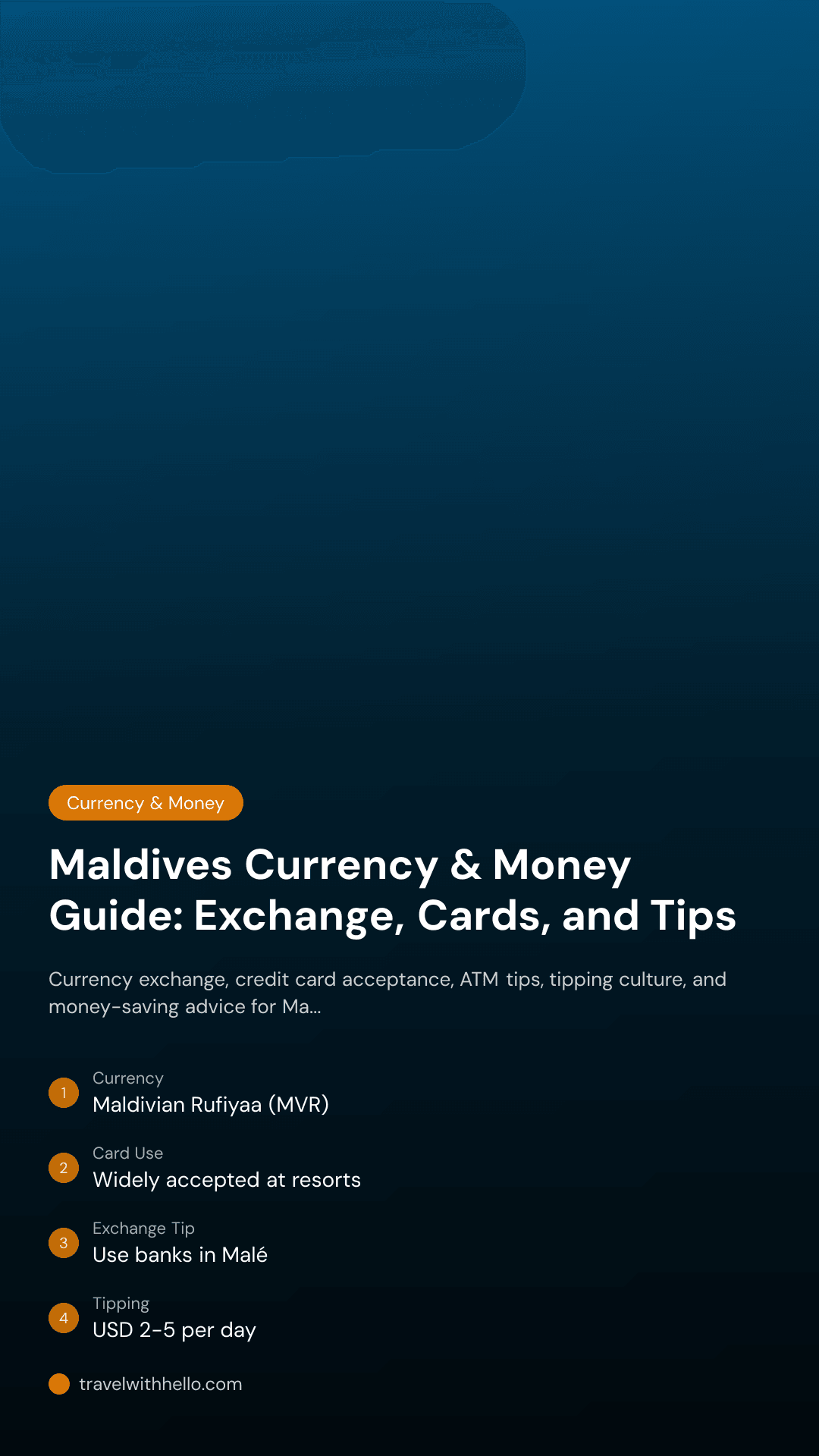
Maldives Currency & Money Tips: TL;DR
The official Maldives currency is the Maldivian rufiyaa (MVR), while US dollars are widely accepted at resorts and tourist businesses. As a practical early-2026 benchmark, S$1 is approximately 11.5–12.2 MVR, although your bank, card network, or exchange counter may apply a different rate. Bring a mix of cards, small US-dollar notes, and some rufiyaa if you plan to visit local islands.
Cards work well at resorts, but cash remains useful for ferries, small cafés, market purchases, taxis, and personal tips. Resort bills commonly include a 10% service charge and 16% tourism GST, so additional tipping is optional rather than compulsory. Use ATMs before travelling to remote islands, check foreign-transaction fees, and track spending with the Hello app’s automatic multi-currency conversion so MVR, USD, and SGD expenses stay easy to understand.
Maldives Currency and Exchange Rate from Singapore Dollars
The Maldivian rufiyaa is the money used for everyday purchases on local islands, while resorts often price accommodation and activities in US dollars; travellers from Singapore should compare the live rate rather than rely on a rounded conversion. The State Bank of India Maldives published an indicative SGD/MVR bid rate of 11.7538 and offer rate of 12.2381 on 25 October 2026, illustrating why exchange counters and card issuers can produce slightly different results.
The rufiyaa is managed closely against the US dollar, which is commonly quoted at roughly US$1 = 15.4 MVR. For quick mental calculations, S$100 may be around 1,150–1,220 MVR before fees, while US$20 is approximately 308 MVR. Treat these as planning figures, not guaranteed settlement rates.
For the best value:
- Check the mid-market SGD-to-MVR rate shortly before departure.
- Avoid converting all your Singapore dollars at the airport.
- Keep receipts and count cash before leaving an exchange counter.
- Choose to be charged in MVR rather than SGD when a card terminal offers dynamic currency conversion.
The Hello app can record purchases in MVR or USD and automatically convert them into your preferred home currency, making your Maldives money tips easier to apply while travelling.
Where to Exchange Money in the Maldives
The most practical exchange strategy is to carry a modest amount of clean US-dollar cash for resorts and tips, then obtain rufiyaa in Malé or Hulhumalé if your itinerary includes local-island travel. Airport counters are convenient on arrival, but convenience does not always mean the most competitive rate, so exchange only enough for immediate transport, snacks, or a ferry.
Licensed banks and established exchange counters in Malé generally offer a safer option than informal street exchanges. Resorts may exchange money for guests, but rates, availability, and currencies vary. Singapore dollars may not be accepted everywhere for cash exchange, so converting some money to US dollars before departure can simplify resort payments. Request smaller denominations, especially US$1, US$5, US$10, and US$20 notes, because they are more useful for tipping than large bills.
Never hand cash to an unofficial tout promising a dramatically better Maldives exchange rate. Count notes at the counter, keep the receipt, and avoid exchanging more rufiyaa than you can reasonably spend: converting leftover MVR back into foreign currency may be inconvenient and may involve a spread. On a resort-only holiday, charging expenses to your room and settling one card transaction can be simpler than repeatedly exchanging cash.
Credit Cards, Contactless Payments, and ATMs
Credit and debit cards are widely accepted at Maldives resorts, hotels, dive centres, restaurants, and travel agencies, but reliable cash access is less predictable on local islands and almost nonexistent on many private resort islands. Visa and Mastercard are the safest cards to carry; American Express and UnionPay acceptance is expanding, but smaller operators may still prefer Visa or Mastercard.
Bank of Maldives merchant services support major card networks and digital wallets including Apple Pay, Google Pay, WeChat Pay, Alipay, and UnionPay at participating businesses. Contactless payment can therefore work in modern resorts and larger establishments, but it should be treated as a convenience rather than a guarantee. Carry a physical backup card and a small cash reserve in case of poor connectivity, terminal problems, or a merchant surcharge.
ATMs are most useful in the Greater Malé area, including Malé and Hulhumalé, and may be available on some larger local islands. Many travellers report combined local-bank and home-bank withdrawal costs of about US$5–10 per transaction, depending on the card issuer and account. To reduce fees:
- Withdraw fewer, larger amounts rather than several small amounts.
- Decline ATM currency conversion and let your bank process the exchange.
- Check overseas withdrawal limits before flying.
- Withdraw before transferring to a remote island.
Maldives Tipping Culture and Service Charges
Tipping in the Maldives is appreciated but usually discretionary because resort bills commonly include a 10% service charge; extra cash is best reserved for staff who provide personal or exceptional service. Check your invoice first so you understand whether the service charge has already been added, then tip according to the quality of service and your budget.
A practical resort tipping guide for 2026 is:
| Service | Typical optional tip | Useful approach |
|---|---|---|
| Housekeeping | US$5–10 per day | Leave daily if staff change regularly |
| Butler or villa host | US$20–50 per stay | Give at the end, based on service |
| Dive guide or instructor | US$10–20 per trip | Tip after a memorable excursion |
| Spa therapist | US$5–10 per treatment | Confirm the service charge first |
| Boat crew or luggage assistance | US$1–5 | Small notes are convenient |
Rufiyaa is helpful for staff on local islands, while clean small US-dollar notes are widely understood at resorts. Avoid assuming that every employee expects a tip, and never feel pressured to pay beyond your means. If travelling with friends, the Hello app can split a shared tip or excursion across multiple currencies and automatically calculate each person’s share.
Digital Payments, Common Scams, and Ways to Save
Digital payments are increasingly available in tourist-facing Maldives businesses, but coverage depends on the merchant, island, and internet connection, so cash and a physical card remain essential backups. Bank of Maldives lists support for BML Pay, Alipay, WeChat Pay, Apple Pay, Google Pay, and UnionPay at participating merchants; PayPay is not a payment method travellers should assume will work widely in the Maldives.
Watch for familiar travel-money problems:
- Dynamic currency conversion that presents an inflated SGD amount at checkout.
- Unofficial exchange offers with hidden commissions or counterfeit notes.
- Card surcharges that were not clearly disclosed before payment.
- Duplicate resort charges caused by delayed or offline terminals.
- ATM skimming; inspect the machine and cover your PIN.
Save money by comparing meal plans with à-la-carte prices, checking whether transfers, taxes, service charges, and activities are included, and avoiding repeated small ATM withdrawals. Local cafés and guesthouses are generally less expensive than private-island resorts, although transport schedules can affect the total cost. For connectivity, Hello eSIM for the Maldives lets travellers buy and activate data before departure, helping them check maps, banking alerts, ferry updates, and expense records without depending entirely on resort Wi-Fi. Use Hello’s budget tracker and AI receipt scanning to categorise spending as soon as you pay.
Common Questions About Maldives Money
The short answer is that most visitors should bring a card, small US-dollar notes, and access to rufiyaa rather than relying on a single payment method. These answers cover the questions travellers most often ask before a Maldives holiday.
What currency should I take to the Maldives? Bring a primary Visa or Mastercard, a backup card, and small US-dollar notes. Use MVR for local-island purchases and keep USD for resort tips or bills when the property accepts it.
Can I use Singapore dollars in the Maldives? Some banks or exchange counters may accept SGD, but it is not the everyday tourist currency. Converting a portion to USD before departure can be more convenient, then compare the live Maldives exchange rate before exchanging further.
Do Maldives resorts accept cards? Most established resorts accept cards and may let guests charge meals, spa treatments, and excursions to the room. Confirm accepted networks and any foreign-card surcharge before arrival.
How much cash should I carry? For a resort stay, small USD notes plus an emergency reserve may be enough. Add rufiyaa if visiting Malé, Hulhumalé, or local islands, where small shops and transport may be cash-based.
Is tipping mandatory in the Maldives? No. A 10% service charge is commonly added, but optional tips are welcomed for personal service. Check the bill before deciding what to add.
Explore These Destinations
Stay Connected
Track your Maldives trip budget
Split expenses with friends, track spending by category, and see real-time currency conversions — all in one app.
Related Articles
Maldives Safety Guide: Tips for a Safe Trip
Safety tips, health advisories, emergency contacts, common scams, and travel insurance advice for Maldives.
19 July 2026
Maldives Visa & Entry Requirements for Singapore Passport Holders
Visa requirements, passport validity, customs allowances, and entry tips for Singapore citizens travelling to Maldives.
10 July 2026
eSIM for Maldives: Best Plans, Coverage, and Setup Tips
Everything you need to know about using eSIM in Maldives. Best data plans, network coverage, and setup instructions.
1 July 2026