Angola Currency & Money Guide: Exchange, Cards, and Tips
Currency exchange, credit card acceptance, ATM tips, tipping culture, and money-saving advice for Angola.
By Hello Travel Team
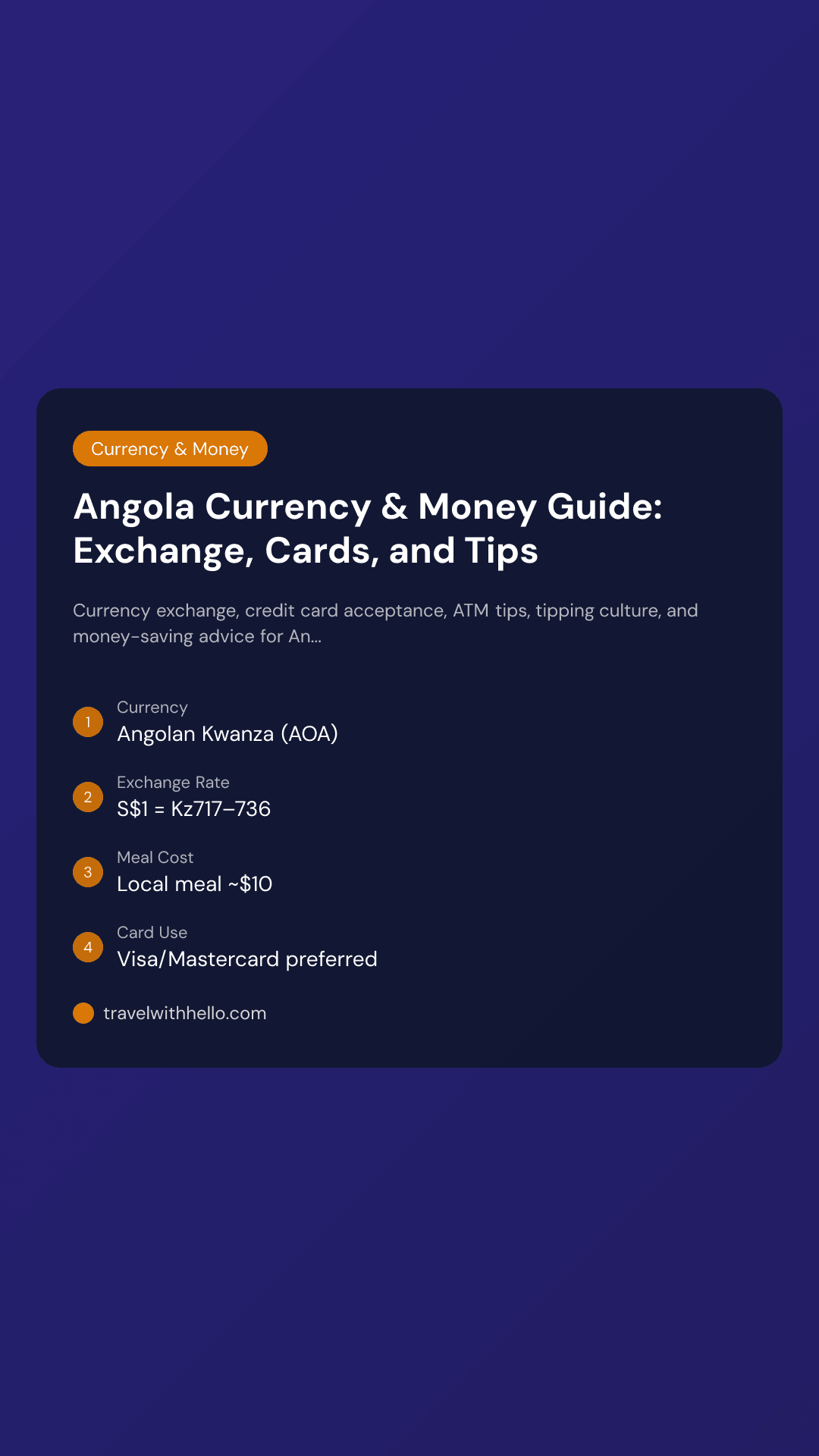
TL;DR: Angola Currency and Money Tips
Angola’s official currency is the Angolan kwanza (AOA), and cash remains essential outside major hotels, restaurants, and supermarkets in Luanda. As a recent mid-market reference, S$1 was approximately Kz717–736 in October 2026, but exchange rates and consumer rates can change quickly, so check a live converter before travelling. Carry small kwanza notes, keep Visa or Mastercard as a backup, and never rely on one ATM or payment method. For trip budgeting, a local restaurant meal may cost around Kz3,000–8,000, while an upscale main course can reach Kz15,000–40,000. The Hello app can track spending in AOA and SGD with automatic exchange-rate conversion, making it easier to monitor your budget while exploring Angola.
Angola Currency and Exchange Rate: What Travellers Need to Know
The Angolan kwanza is the currency you will use for everyday purchases in Angola, and travellers should exchange enough money for transport, meals, markets, and smaller businesses before leaving major urban areas. The currency code is AOA and prices are commonly written with “Kz.” As a recent October 2026 mid-market indication, S$1 converted to roughly Kz717–736, while Kz1 was worth about S$0.0014; the rate offered by a bank, exchange counter, or card network may be less favourable after fees and margins.
Use a live exchange-rate tool shortly before departure and again when you arrive. The mid-market rate is a useful benchmark, not a guaranteed cash rate. Avoid exchanging money informally on the street, even if the quoted rate looks attractive, because counterfeit notes, theft, and disputes are possible.
Practical reminders:
- Carry a calculator or use your phone to convert large prices.
- Learn the difference between Kz1,000 and Kz10,000 when handling unfamiliar notes.
- Keep emergency cash separately from your wallet.
- Ask for a receipt when exchanging money and count the kwanza before leaving the counter.
Hello’s multi-currency expense tracker can automatically convert AOA spending into SGD, while AI receipt scanning and voice entry help record purchases even when receipts or notes are in unfamiliar formats.
Where to Exchange Money in Angola and How to Avoid Bad Rates
The safest approach is to exchange money through authorised banks or established exchange bureaux, then use ATMs in busy, well-secured locations when necessary. Luanda offers the greatest choice, particularly around major hotels, shopping centres, banks, and business districts, while options become more limited in provincial towns and rural areas. Do not assume that US dollars or euros will be accepted everywhere: some tourist-facing businesses may take foreign currency, but ordinary shops, taxis, markets, and local restaurants generally require kwanza.
Before exchanging, compare the displayed rate with a live SGD-to-AOA reference and ask whether a commission is included. Exchange smaller amounts at first if you are unsure about the provider. Street exchange is best avoided because unofficial transactions can involve counterfeit cash, theft, or legal problems.
A sensible arrival plan is:
- Bring a modest emergency reserve in clean, widely accepted foreign banknotes.
- Exchange or withdraw enough kwanza for your first day, including airport transport and meals.
- Keep some small denominations for bottled water, short taxi rides, tips, and market purchases.
- Store cash in two separate places rather than carrying everything in a day bag.
Outside Luanda, plan more conservatively: exchange opportunities may be infrequent, ATMs may be unreliable, and many businesses may not be able to give change for large notes.
Credit Cards, Contactless Payments, and ATMs in Angola
Visa and Mastercard are most useful in Angola’s major hotels, upscale restaurants, larger supermarkets, and international-facing businesses, but card acceptance is inconsistent and cash remains the dependable option. American Express is rarely accepted, and even a working Visa or Mastercard terminal may fail because of network, power, connectivity, or bank issues. Contactless payment availability is limited compared with Singapore and should be treated as a convenience rather than a travel plan.
Multicaixa ATMs are concentrated in Luanda and provincial capitals, with very limited coverage in rural areas. Traveller reports commonly describe withdrawal limits around the equivalent of US$100–200, although limits vary by bank and card. Your home bank may charge an international withdrawal fee of roughly US$3–5, in addition to any local fee or exchange-rate markup.
Use ATMs safely:
- Choose machines inside banks, shopping centres, or hotels during daylight.
- Try a different bank if the first ATM rejects your card.
- Withdraw enough for the next day or two, but avoid carrying your entire trip budget.
- Decline dynamic currency conversion when offered and choose to be charged in AOA.
- Keep your card issuer’s emergency number offline.
Before departure, notify your bank, confirm overseas withdrawals are enabled, and carry at least two payment cards. An eSIM from Hello can help maintain connectivity for banking alerts, maps, and payment verification; see Hello eSIM for Angola.
Angola Tipping Culture: Restaurants, Hotels, Guides, and Taxis
Tipping in Angola is appreciated but not compulsory, and the right amount depends on service quality and whether a service charge already appears on the bill. In restaurants, around 10% is customary when service is not included; check the receipt before adding anything. Tipping is more common in Luanda’s hotels and international restaurants than in small local eateries, where rounding up may be enough.
Useful Angola tipping guidelines include:
| Service | Practical amount | Notes |
|---|---|---|
| Restaurant | About 10% | Add only if service charge is absent |
| Hotel porter | Kz500–1,000 or equivalent | Per bag is a reasonable guide |
| Housekeeping | Kz500–1,000 per day | Leave daily rather than at checkout |
| Full-day guide | US$10–20 equivalent | Adjust for group size and service |
| Taxi driver | Round up or about 10% | Usually optional |
Use kwanza whenever possible, particularly for small tips. Foreign cash can be inconvenient for staff to exchange, and large notes may be difficult to break. If a taxi driver provides exceptional help with luggage or directions, rounding up is a friendly gesture, but taxis generally do not require a formal gratuity. Keep tipping discreet and avoid displaying your full wallet in busy areas.
Everyday Costs and Ways to Save Money in Angola
Angola can be expensive for international visitors, especially in Luanda, where accommodation, imported food, and private transport may approach Western European prices. A recent travel-cost guide estimates a budget traveller may spend roughly US$50–100 per day, while a mid-range trip can cost about US$150–300 per day, excluding international flights. Local prices vary widely, so treat these as planning ranges rather than fixed tariffs.
Indicative everyday prices include:
- 500 ml bottled water: about Kz200–500.
- Local restaurant meal: roughly Kz3,000–8,000.
- Upscale restaurant main course: approximately Kz15,000–40,000.
- Taxi across central Luanda: around Kz3,000–8,000.
Save money by eating at busy local restaurants, buying water in larger supermarkets, comparing taxi fares before travelling, and choosing accommodation that includes breakfast. Keep small notes for quick purchases and confirm prices before ordering in markets or informal transport. Avoid paying in foreign currency unless the exchange rate is clearly agreed in advance.
For group travel, record shared transport, meals, and accommodation immediately. Hello supports expense splitting across multiple currencies, automatic conversion, AI categorisation, receipt scanning, voice expense entry, and bank-statement import. That makes it easier to see whether a Kz40,000 dinner was a one-off treat or the reason the daily budget has slipped.
Common Questions About Angola Money and Payments
Travellers usually manage money in Angola successfully by combining kwanza cash, two payment cards, and a realistic plan for ATM access. The most important rule is simple: use cards where they work, but always keep enough local currency for transport, smaller businesses, outages, and travel beyond Luanda.
Can I use Singapore dollars in Angola? Singapore dollars are not practical for everyday payments. Convert them through an authorised provider or use a suitable international card, then obtain kwanza for daily spending.
Should I bring US dollars or euros? They can be useful as emergency exchange currency, but clean notes do not guarantee acceptance. Do not depend on foreign cash for restaurants, taxis, or rural purchases.
Are ATMs easy to find? ATMs are relatively common in Luanda and provincial capitals but may be scarce, empty, offline, or subject to withdrawal limits. Withdraw during the day and keep a backup payment method.
Does Angola use WeChat Pay or PayPay? WeChat Pay and Japan’s PayPay are not standard payment methods for ordinary travellers in Angola. Local fintech services exist, but visitors should not assume that foreign QR-payment apps will work. Visa, Mastercard, and kwanza cash are more practical.
How much cash should I carry? Carry enough for one or two days of ordinary expenses plus an emergency reserve, while avoiding a single large bundle. Split cash between secure locations and update your budget in the Hello app as you spend.
Explore These Destinations
Stay Connected
Track your Angola trip budget
Split expenses with friends, track spending by category, and see real-time currency conversions — all in one app.
Related Articles
Angola Safety Guide: Tips for a Safe Trip
Safety tips, health advisories, emergency contacts, common scams, and travel insurance advice for Angola.
3 November 2026
Angola Visa & Entry Requirements for Singapore Passport Holders
Visa requirements, passport validity, customs allowances, and entry tips for Singapore citizens travelling to Angola.
3 November 2026
eSIM for Angola: Best Plans, Coverage, and Setup Tips
Everything you need to know about using eSIM in Angola. Best data plans, network coverage, and setup instructions.
3 November 2026